
Buying property in Dubai is a major financial decision, and one of the first questions buyers often face is whether to pay for the property entirely with cash or use mortgage financing.
The choice between Cash vs Mortgage in Dubai can affect your upfront investment, monthly financial commitments, liquidity, financing costs and overall property strategy.
A cash buyer may avoid mortgage financing costs and monthly loan repayments, while a mortgage can allow an eligible buyer to purchase property without committing the entire purchase price upfront.
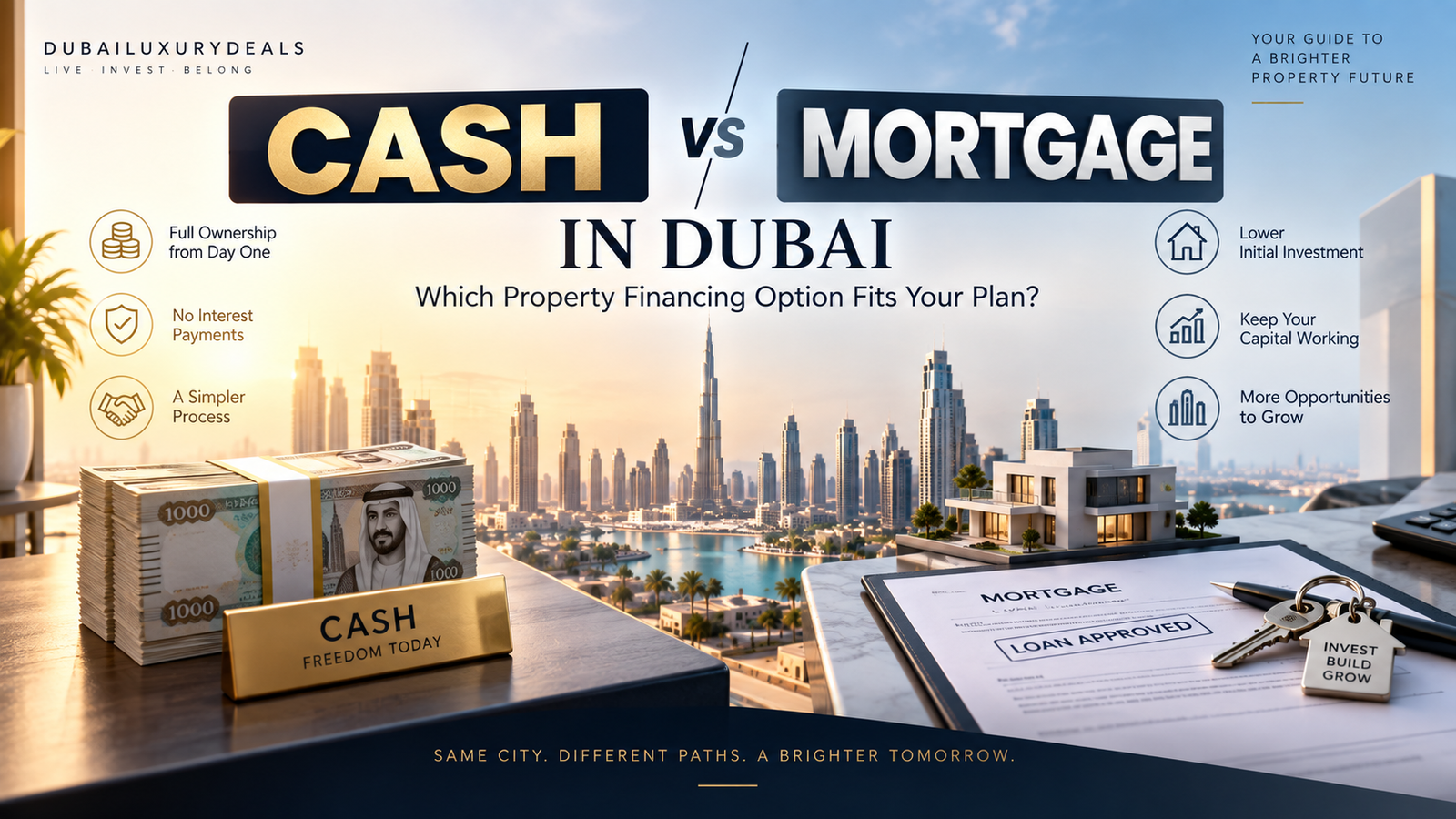
However, there is no single financing method that works for every buyer. Your available capital, income, property type, investment plans, expected holding period and financial objectives all need to be considered.
In this guide, DubaiLuxuryDeals explains Cash vs Mortgage in Dubai, including how each option works, down payments, DLD fees, mortgage registration, liquidity, financing requirements, investment considerations and questions to ask before buying.
Disclaimer: This article is for general informational purposes only and does not constitute financial, mortgage, investment, legal or tax advice. Mortgage eligibility, interest rates, fees and government requirements can change. Buyers should verify current requirements with the relevant authorities and financial institutions before making a property purchase.
Cash vs Mortgage in Dubai: What’s the Difference?
The basic difference is simple.
Buying With Cash
A cash buyer pays the property’s purchase price using their own available funds instead of taking a mortgage.
Buying With a Mortgage
A mortgage buyer contributes part of the purchase price and borrows the remaining eligible amount from a bank or approved financing institution.
For example, if a Dubai property costs AED 2 million, a cash buyer may fund the entire purchase price from their own capital.
A mortgage buyer may contribute a down payment and finance part of the remaining value, subject to the lender’s assessment and applicable regulatory limits.
The Central Bank of the UAE establishes maximum loan-to-value requirements for different mortgage categories, while individual banks may apply more conservative lending criteria.
For official mortgage regulations, buyers can refer to the Central Bank of the UAE Rulebook.
Buying Property in Dubai With Cash
A cash property purchase means you do not use a mortgage to finance the property.
Your available funds generally need to cover:
- Property purchase price
- DLD registration fees
- Title deed and map charges
- Trustee/service-centre charges where applicable
- Agency fees, if applicable
- Developer or administrative charges where applicable
- Other transaction expenses
For eligible property sales, Dubai Land Department provides an official property sale registration process. DLD currently lists 2% of the sale value for the buyer and 2% for the seller, together with additional applicable charges.
You can check the current requirements directly through the Dubai Land Department Property Sale Registration service.
How Does a Cash Property Purchase Work?
A typical ready-property transaction can involve:
Choose a property
↓
Agree on the purchase price
↓
Complete due diligence
↓
Sign the required transaction documents
↓
Arrange the purchase funds
↓
Complete NOC and other required documentation
↓
Register the sale
↓
Receive ownership documentation
The exact process can vary depending on the property and transaction.
Dubai Land Department states that its property sale registration service can result in an electronic title deed and electronic map.
Potential Benefits of Buying Property With Cash
No Mortgage Financing
A cash buyer does not need to take a mortgage against the property.
As a result, there is no mortgage interest or profit cost associated with financing that property.
No Monthly Mortgage Payment
A cash buyer does not have a regular mortgage installment.
However, property ownership can still involve ongoing expenses such as:
- Service charges
- Maintenance
- Property management
- Insurance where applicable
- Utilities
- Repairs
Simpler Financing Structure
A cash purchase does not normally require mortgage underwriting.
The buyer therefore does not need to go through the same bank approval process associated with a mortgage.
This can simplify the financing side of the transaction.
What Should Cash Buyers Consider?
The biggest consideration is often liquidity.
Imagine you have AED 3 million available and purchase a property for AED 2 million in cash.
After the purchase and transaction costs, a significant portion of your capital is tied to the property.
That may be perfectly appropriate for your financial plan, but it means less money is immediately available for:
- Other investments
- Another property
- Business opportunities
- Emergency reserves
- Personal financial requirements
Therefore, Cash vs Mortgage in Dubai should not be evaluated only by asking which option has fewer financing costs.
You should also consider what happens to your remaining capital after the transaction.
Buying Property in Dubai With a Mortgage
A mortgage allows an eligible buyer to finance part of the property purchase through a bank or other approved financial institution.
The buyer normally provides an initial contribution and finances the remaining eligible amount.
For example:
Property price: AED 2,000,000
Illustrative buyer contribution: AED 500,000
Illustrative mortgage: AED 1,500,000
This is only an example. The actual amount available depends on the buyer, property, lender, valuation and applicable LTV requirements.
The Central Bank of the UAE’s current mortgage framework distinguishes between owner-occupied properties, subsequent/investment properties and off-plan purchases.
How Much Down Payment Is Required in Dubai?
There is no single down-payment percentage for every Dubai property buyer.
Under the current CBUAE mortgage framework, the maximum LTV for expatriates buying a first/owner-occupied property is:
- Up to 80% for property valued at AED 5 million or less
- Up to 70% for property valued above AED 5 million
- Up to 60% for subsequent/investment properties
- Up to 50% for off-plan schemes
For UAE nationals, the published limits are different.
The CBUAE also states that these are maximum allowable LTV levels and that individual lenders may adopt more conservative limits.
Therefore, a buyer should not assume that the maximum regulatory LTV automatically represents the financing amount a bank will approve.
Mortgage Costs Beyond the Down Payment
When comparing Cash vs Mortgage in Dubai, remember that a mortgage involves costs beyond the down payment.
Depending on the transaction, these can include:
- DLD property registration
- Mortgage registration
- Bank processing fees
- Property valuation
- Insurance
- Agency fees
- Trustee/service-centre charges
- Other applicable administrative costs
The actual charges depend on the lender and transaction.
Dubai Mortgage Registration Fee
Dubai Land Department currently lists the mortgage registration fee at 0.25% of the mortgage value for the applicable registration process.
Example
Suppose your mortgage is:
AED 1,500,000
At 0.25%:
AED 3,750
This is only the mortgage-registration component and should not be confused with the total cost of obtaining a mortgage.
For current information, visit the Dubai Land Department – Registering the Sale of a Mortgaged Property.
DLD Property Registration Fees
DLD’s current property sale registration service lists:
Seller: 2% of sale value
Buyer: 2% of sale value
It also lists additional charges for title deed issuance, maps and service partners.
For example, on a property worth:
AED 2,000,000
A 2% buyer-side fee would equal:
AED 40,000
This is an illustration of the applicable fee component, not the complete transaction cost.
Buyers should confirm the exact costs applicable to their transaction through the official DLD service.
Cash vs Mortgage in Dubai: Example of a AED 2 Million Property
Let’s compare a simplified example.
Cash Purchase
Property price: AED 2,000,000
The buyer provides the full purchase price from available capital.
The buyer must also budget for applicable:
- DLD charges
- Registration expenses
- Agency fees
- Administrative costs
- Other transaction costs
There is no mortgage balance after completion.
Mortgage Purchase
Now suppose the buyer contributes:
AED 500,000
and finances:
AED 1,500,000
The buyer would need to consider:
- Down payment
- DLD property registration
- Mortgage registration
- Bank fees
- Property valuation
- Insurance where applicable
- Monthly mortgage payments
- Total financing cost
The mortgage route therefore requires less capital to be committed to the purchase price initially, but creates an ongoing financial obligation.
Cash vs Mortgage in Dubai: Side-by-Side Comparison
| Factor | Cash Purchase | Mortgage Purchase |
|---|---|---|
| Property price funded upfront | Entire amount | Part of amount |
| Mortgage | No | Yes |
| Monthly mortgage payment | No | Yes |
| Mortgage financing cost | No | Yes |
| Bank approval | Generally not required | Required |
| Property valuation | Generally not required by a lender | Typically required |
| Mortgage registration | No | Yes |
| Liquidity after purchase | Potentially lower | Potentially higher |
| Financing paperwork | Lower | Higher |
| Debt obligation | No mortgage debt | Yes |
| Capital available elsewhere | Potentially lower | Potentially higher |
| Financing risk | No mortgage-rate exposure | Depends on financing terms |
This comparison describes the structural differences. The financial suitability of either option depends on the buyer’s circumstances.
Liquidity Is an Important Part of the Decision
When considering Cash vs Mortgage in Dubai, ask yourself:
How much money will I have left after buying the property?
This question is particularly important for investors.
Suppose you have:
AED 4 million available
and want to purchase:
AED 2.5 million property
A cash purchase would commit most of the property’s price immediately.
With financing, you may be able to retain some capital.
But retaining capital is only useful if you have a sensible purpose for it.
For example, the remaining funds could be used for:
- Another property
- Business expansion
- Diversified investments
- Emergency reserves
- Future property purchases
The potential return and risk of those alternatives should be evaluated separately.
Cash vs Mortgage for Dubai Investment Property
For an investment property, the calculation becomes more detailed.
Instead of looking only at the property price, investors should consider:
- Purchase price
- Down payment
- Mortgage cost
- Rental income
- Service charges
- Property management
- Maintenance
- Vacancy periods
- Insurance
- DLD fees
- Agency fees
- Expected holding period
- Potential resale costs
A simple rental cash-flow calculation could be:
Rental income
− Mortgage payment
− Service charges
− Management costs
− Maintenance
− Other expenses
= Estimated cash flow
This can help investors understand the property’s financial structure more realistically.
Should Rental Income Be Used to Pay the Mortgage?
Rental income can contribute toward mortgage payments, but it should not automatically be treated as guaranteed income.
A property may experience:
- Vacancy periods
- Tenant turnover
- Maintenance expenses
- Rental-market changes
- Service-charge increases
- Unexpected repairs
Therefore, investors should assess whether they can continue making mortgage payments if rental income is temporarily lower than expected.
Cash vs Mortgage for Off-Plan Property
Off-plan properties require additional consideration.
Developers may offer payment plans that spread the purchase price across multiple stages.
For example, a project could have payments linked to:
- Booking
- Contract signing
- Construction milestones
- Completion
- Handover
However, mortgage financing for off-plan property is subject to specific regulatory limits.
The CBUAE currently sets a maximum LTV of 50% for off-plan schemes, regardless of purpose, property value or borrower category.
This means an off-plan buyer considering financing should speak to the lender early in the process rather than assuming that the same financing percentage available for a completed property will apply.
Can Foreigners Get a Mortgage in Dubai?
Mortgage financing can be available to expatriates and other eligible buyers, but individual bank requirements vary.
A lender may consider:
- Residency status
- Nationality
- Monthly income
- Employment
- Existing debts
- Credit history
- Property value
- Property type
- Loan amount
- Relationship with the bank
The CBUAE mortgage regulations apply to regulated mortgage providers lending to UAE nationals, GCC nationals and expatriates.
For non-resident buyers, requirements can vary significantly between lenders.
Therefore, obtaining a financing assessment before signing a property purchase commitment can be useful.
Debt Burden Ratio and Dubai Mortgages
Mortgage eligibility is not based solely on property value.
The CBUAE currently applies a maximum debt-burden ratio of:
50% of gross monthly income for expatriates
and
60% for UAE nationals, subject to the applicable regulatory framework.
This means a buyer’s existing financial commitments can affect the amount of mortgage financing they can obtain.
Existing obligations may include:
- Personal loans
- Car finance
- Credit-card obligations
- Other mortgages
- Other recurring debt commitments
Mortgage Term in Dubai
The CBUAE mortgage framework currently provides for a maximum mortgage tenor of 25 years.
A longer loan term can reduce the individual monthly payment, but it may increase the total amount paid over the life of the financing.
A shorter term can mean larger monthly payments while potentially reducing the overall financing period.
Therefore, buyers should compare:
Monthly payment
and
Total financing cost
rather than looking at the monthly installment alone.
What Happens When You Sell a Mortgaged Property?
Selling a property with an outstanding mortgage involves additional procedures.
Dubai Land Department provides a dedicated process for registering the sale of a mortgaged property.
According to DLD, the process can involve a bank liability letter, settlement of the outstanding debt, mortgage release and completion of the sale registration.
The process can broadly involve:
- Obtain the bank’s liability letter
- Determine the outstanding mortgage amount
- Arrange settlement
- Obtain the mortgage release documentation
- Complete the sale process
- Register the new ownership
The exact procedure depends on the transaction.
For official requirements, visit the DLD – Registering the Sale of a Mortgaged Property.
Is Cash More Flexible When Selling?
A property without a mortgage generally has fewer lender-related requirements when it is sold.
DLD also provides specific requirements for transactions involving mortgaged properties.
This does not mean that every cash purchase is automatically easier overall, because the sale still requires the applicable property documentation and registration process.
Cash vs Mortgage in Dubai for Luxury Properties
The decision can become more significant for high-value properties.
Consider a luxury property priced at:
AED 10 million
A relatively small change in financing percentage can represent a substantial amount of money.
A buyer should therefore calculate:
- Required equity
- DLD fees
- Mortgage registration
- Financing costs
- Monthly repayments
- Service charges
- Liquidity
- Investment objectives
- Expected holding period
For higher-value properties, buyers should confirm the applicable LTV limits and bank requirements before making assumptions about available financing. The CBUAE framework distinguishes between property values and borrower/property categories.
Questions to Ask Your Bank Before Taking a Mortgage
Before accepting a mortgage offer, ask the lender:
Interest or Profit Rate
- What is the current rate?
- Is it fixed or variable?
- When can it change?
Fees
- What is the processing fee?
- Is there a valuation fee?
- What insurance is required?
- Are there other charges?
Early Settlement
- Can I repay early?
- What charges apply?
- Can I refinance?
Monthly Payment
- What is the expected monthly installment?
- What happens if the rate changes?
Eligibility
- What documents are required?
- What is the maximum financing amount?
- How do my existing debts affect eligibility?
The CBUAE mortgage framework includes transparency and disclosure requirements for real-estate lending, while individual lenders determine their own approved products and conditions within the regulatory framework.
Common Mistakes When Comparing Cash vs Mortgage in Dubai
1. Looking Only at the Down Payment
A lower initial contribution does not necessarily mean a lower overall cost.
Mortgage financing costs must be included.
2. Using All Your Cash
A cash purchase can leave less liquidity after the transaction.
Always consider your emergency reserve and other financial commitments.
3. Assuming Rental Income Is Guaranteed
Rental income can fluctuate.
Include vacancy periods, maintenance and service charges in your calculations.
4. Forgetting Transaction Costs
The property price is only one part of the purchase budget.
Consider:
- DLD fees
- Mortgage registration
- Bank fees
- Agency fees
- Valuation
- Insurance
- Trustee/service charges
5. Assuming You Will Automatically Qualify for the Maximum LTV
The CBUAE establishes maximum regulatory LTV limits, but lenders can apply more conservative criteria.
6. Comparing Only Monthly Payments
A mortgage with a lower monthly payment can have a longer repayment period.
Compare the total financing cost, not only the monthly amount.
A Simple Cash vs Mortgage Calculation
Let’s consider another illustrative example.
Property Value
AED 3,000,000
Cash Purchase
Buyer provides:
AED 3,000,000
plus applicable transaction costs.
Mortgage Purchase
Suppose the buyer contributes:
AED 900,000
and obtains:
AED 2,100,000 mortgage
The buyer now retains more of their capital but takes on:
- Monthly repayments
- Financing costs
- Mortgage registration
- Bank charges
- Other financing requirements
The correct comparison is therefore not simply:
AED 3 million vs AED 900,000
Instead, compare:
Total cash required + total financing cost + remaining liquidity + expected investment return/risk.
Cash vs Mortgage in Dubai: Which Factors Matter Most?
Before choosing a financing structure, consider:
1. Your Available Capital
How much can you comfortably commit?
2. Your Monthly Income
Can you comfortably manage mortgage payments?
3. Your Existing Debt
Do you already have substantial financial obligations?
4. Your Emergency Reserve
How much cash will remain after the transaction?
5. Your Investment Objective
Are you buying:
- A primary residence?
- A rental property?
- A second home?
- A long-term investment?
- An off-plan property?
6. Your Holding Period
How long do you expect to keep the property?
7. Your Alternative Uses of Capital
Could the money you retain through financing be used elsewhere?
8. Your Financing Cost
What will the mortgage cost over its full term?
Cash vs Mortgage in Dubai: Practical Checklist
Before purchasing property, calculate:
☐ Property purchase price
☐ Available cash
☐ Required down payment
☐ DLD registration fees
☐ Mortgage registration fee
☐ Bank processing fees
☐ Property valuation
☐ Insurance costs
☐ Agency fees
☐ Monthly mortgage payment
☐ Total financing cost
☐ Expected rental income
☐ Service charges
☐ Maintenance
☐ Emergency reserve
☐ Expected holding period
☐ Exit strategy
☐ Alternative use of capital
Frequently Asked Questions About Cash vs Mortgage in Dubai
Is it better to buy property in Dubai with cash or a mortgage?
There is no universal answer. Cash vs Mortgage in Dubai depends on the buyer’s capital, income, liquidity, financing costs, property type and financial objectives.
What is the maximum mortgage LTV in Dubai?
For expatriates, the current CBUAE framework provides maximum LTV levels of up to 80% for a first/owner-occupied property valued at AED 5 million or less, 70% above AED 5 million, 60% for subsequent/investment property and 50% for off-plan schemes.
These are maximum regulatory levels; an individual bank may offer less.
What is the DLD mortgage registration fee?
DLD currently lists the mortgage registration fee at 0.25% of the mortgage value for the applicable service.
What is the DLD property registration fee?
DLD’s current property sale registration service lists 2% of the sale value for the buyer and 2% for the seller, in addition to other applicable charges.
Can foreigners get mortgages in Dubai?
Mortgage lending can be available to eligible expatriate buyers, subject to the lender’s criteria and applicable CBUAE regulations.
Can I get a mortgage for an off-plan property?
Mortgage financing can be available subject to the lender and applicable requirements. The CBUAE currently sets a maximum LTV of 50% for off-plan schemes.
Can I sell a property that still has a mortgage?
Yes, but additional procedures are involved. DLD provides a specific process involving the bank liability, settlement and mortgage release before the sale is completed.
Does buying with cash mean there are no additional costs?
No. Cash buyers can still have DLD registration fees, title deed/map charges, agency fees and other applicable transaction costs.
Final Thoughts on Cash vs Mortgage in Dubai
The decision between Cash vs Mortgage in Dubai should be based on the complete financial picture rather than one factor.
A cash purchase means committing more capital upfront but avoids mortgage financing and monthly loan repayments.
A mortgage can allow an eligible buyer to spread the cost of the property and retain more capital, but it introduces financing costs, monthly obligations and lender requirements.
Before making a decision, compare:
Purchase Price
- DLD & Transaction Costs
- Mortgage Costs, If Applicable
- Monthly Obligations
- Liquidity After Purchase
- Expected Property Income
- Alternative Use of Capital
This approach provides a more complete picture of the financial implications of buying property in Dubai.
For official property-registration information, buyers should check the Dubai Land Department.
For mortgage regulations and current regulatory requirements, refer to the Central Bank of the UAE Rulebook.
Looking for property opportunities in Dubai? Explore DubaiLuxuryDeals for Dubai real estate guides, property opportunities and information for buyers and investors.
