
Dubai has long been seen as a global safe haven for real estate investors—offering tax benefits, high rental yields, and a stable business environment. However, the ongoing Israel–Iran conflict in 2026 has introduced a new layer of uncertainty in the Middle East.
For investors exploring opportunities through platforms like DubaiLuxuryDeals, the key question is:
Is this a temporary market reaction or a long-term risk?
Let’s break down the real impact—separating short-term fear from long-term growth potential.
Understanding the Current Situation
The geopolitical tension between Israel and Iran has escalated into a broader regional conflict, affecting trade routes, oil supply, and investor sentiment. This has had a ripple effect across Gulf economies, including the UAE.
Recent reports show that:
- Dubai real estate transactions have slowed significantly in the short term
- Investor sentiment has weakened due to regional instability
- Property developers and investors are facing cautious market conditions
At the same time, global economic disruptions—especially oil price volatility—are influencing real estate markets worldwide.
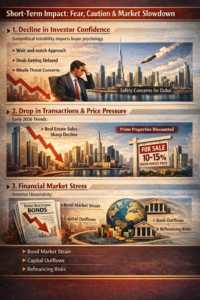
Short-Term Impact: Fear, Caution & Market Slowdown
1. Decline in Investor Confidence
Dubai’s real estate boom has been heavily driven by international buyers. But geopolitical instability directly impacts buyer psychology.
- Some investors are adopting a “wait-and-watch” approach
- Transactions are getting delayed
- High-value deals are seeing slower closures
Additionally, missile threats and regional tensions have temporarily shaken Dubai’s image as a completely safe investment destination.
2. Drop in Transactions & Price Pressure
Early data indicates:
- Real estate transactions dropped sharply in early 2026
- Some prime properties are being sold at 10–15% discounts
With over 100,000+ new units entering the market, increased supply combined with reduced demand may create short-term price pressure.
3. Financial Market Stress
The impact isn’t limited to property sales alone:
- Real estate bonds in Dubai are facing stress
- Investors are concerned about refinancing risks
- Global funds are temporarily reallocating capital
This reflects a broader pattern—fear-driven decision-making rather than structural weakness.
The Bigger Picture: Why Dubai Still Stands Strong
While short-term signals may seem negative, the foundation of Dubai’s real estate market remains incredibly strong.
1. Proven Market Resilience
Dubai has survived multiple global crises:
- 2008 financial crash
- COVID-19 pandemic
- Oil price shocks
Each time, the market not only recovered—but grew stronger.
In fact:
- Property prices surged 60% between 2022–2025
- 2025 saw record-breaking transaction volumes and investor participation
This shows that Dubai’s growth is not fragile—it’s cyclical and resilient.
2. Strong Long-Term Demand Drivers
Despite geopolitical tensions, key fundamentals remain intact:
- Continuous population growth (driven by expats)
- Investor-friendly policies (Golden Visa, tax-free income)
- Global business hub positioning
- Infrastructure and luxury development pipeline
Experts suggest that the current conflict is likely to impact sentiment—not fundamentals.
3. Dubai as a Wealth Safe Haven
Ironically, geopolitical instability often strengthens Dubai’s appeal in the long run.
Why?
- Investors shift capital from unstable regions to safer alternatives
- Dubai remains one of the most politically stable and business-friendly cities in the region
- High-net-worth individuals prefer tangible assets like real estate during uncertainty
Even amid the conflict, some luxury property deals are still happening—highlighting continued long-term confidence.
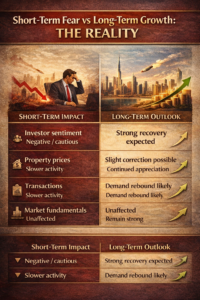
Short-Term Fear vs Long-Term Growth: The Reality
| Factor | Short-Term Impact | Long-Term Outlook |
| Investor sentiment | Negative / cautious | Strong recovery expected |
| Property prices | Slight correction possible | Continued appreciation |
| Transactions | Slower activity | Demand rebound likely |
| Market fundamentals | Unaffected | Remain strong |
What Should Investors Do Now?
1. Look for Strategic Buying Opportunities
Market slowdowns often create discounted premium deals—especially in luxury and off-plan properties.
2. Focus on Long-Term ROI
Dubai real estate is not a short-term flip market anymore. Investors should:
- Target rental yield
- Focus on capital appreciation over 3–5 years
3. Diversify Within Dubai
Instead of avoiding the market, smart investors are:
- Diversifying across locations
- Investing in high-demand zones
- Exploring branded residences and luxury segments
Final Verdict
The Israel–Iran conflict has undoubtedly introduced short-term uncertainty in Dubai’s real estate market. However, this is a temporary sentiment-driven slowdown—not a structural collapse.
Dubai’s fundamentals—economic strength, global demand, and investor-friendly policies—remain unchanged.
👉 Short-term fear creates hesitation.
👉 Long-term vision creates wealth.
For investors working with platforms like DubaiLuxuryDeals, this phase could actually be the best time to enter the market strategically.
