
Dubai’s real estate market continues to evolve, with new planning initiatives creating opportunities across established residential neighbourhoods. One of the latest developments is the revision of the Al Satwa Building Regulations, which introduces greater flexibility for residential and commercial construction in this centrally located Dubai community.
On 1 November 2026, Dubai Municipality announced updated planning rules that allow different building heights depending on plot location and characteristics. The changes include residential apartment development on internal-road plots, mixed-use development along external roads and additional construction potential for qualifying plots measuring 1,000 square metres or more.
The most significant change is the possibility of developing a ground floor plus eight residential floors (G+8) on qualifying larger plots, with a floor area ratio (FAR) of up to 3.5.
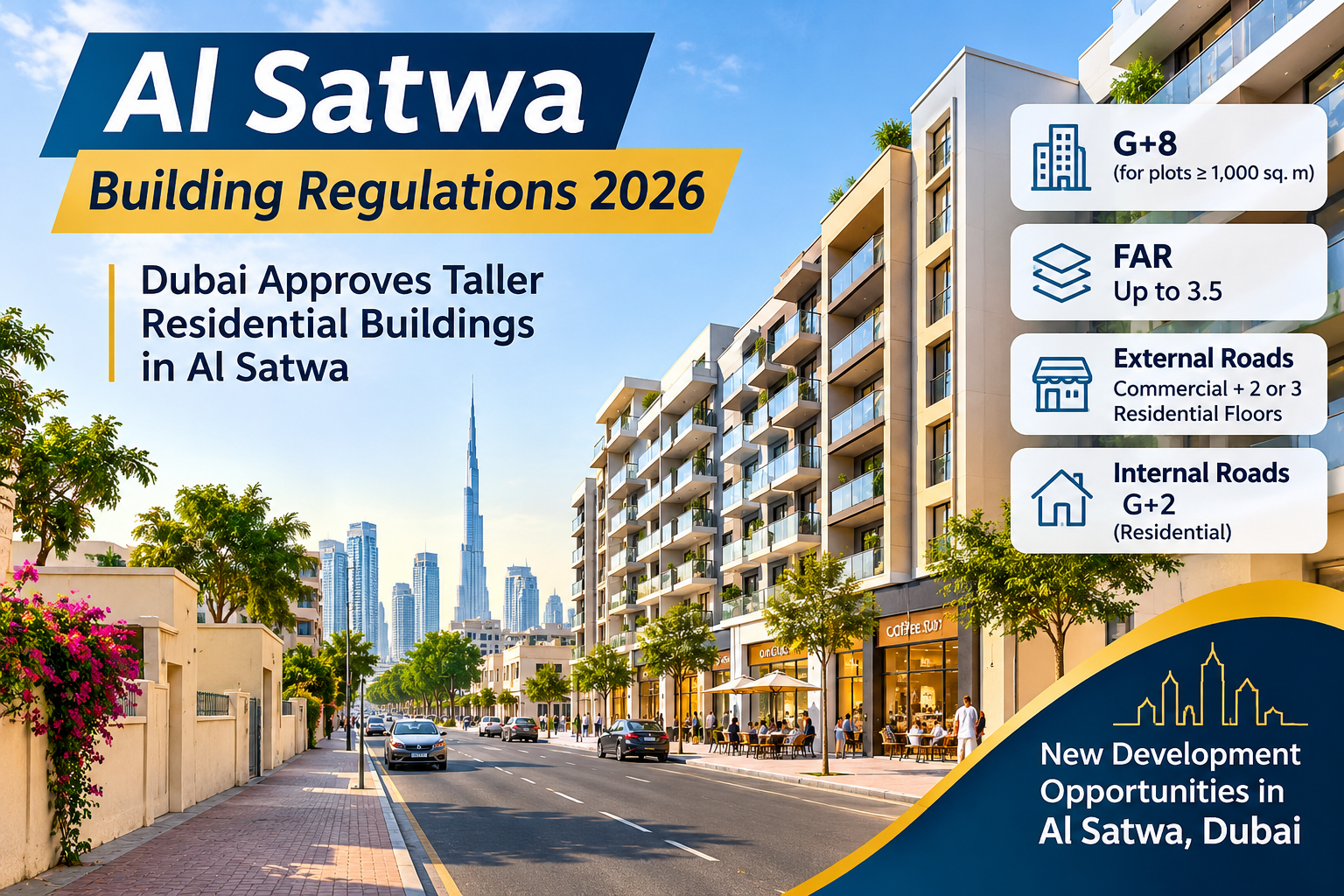
For landowners, property developers and real estate investors, the Al Satwa Building Regulations could create new opportunities to explore redevelopment in one of Dubai’s established neighbourhoods.
But what exactly has changed? Which plots qualify for taller buildings? Can smaller plots be combined? And what could these changes mean for property owners and investors?
This guide explains the latest planning framework, development permissions, plot consolidation requirements and potential investment implications.
Table of Contents
- Overview of the Al Satwa Building Regulations
- What Has Dubai Municipality Approved?
- Understanding the New G+8 Building Permission
- Plot Consolidation and the 1,000 Sq. M Requirement
- Understanding FAR 3.5
- Why Is Dubai Updating Al Satwa’s Planning Framework?
- How Will the Changes Affect Property Owners?
- Opportunities for Real Estate Developers
- What Could Change for Residents and Tenants?
- Al Satwa Location and Connectivity
- Potential Impact on Dubai’s Property Market
- Important Checks Before Investing
- Frequently Asked Questions
1. Overview of the Al Satwa Building Regulations
Al Satwa is an established residential neighbourhood in Dubai, located close to Jumeirah, Al Jafiliya, World Trade Centre and other important destinations.
The area has traditionally featured low-rise residential buildings, attached villas, local shops and neighbourhood businesses. Its established urban character makes it different from many of Dubai’s newer high-rise residential communities.
The latest Al Satwa Building Regulations introduce more flexible development possibilities based on the location and characteristics of individual plots.
Under the updated planning framework:
- Internal-road plots can accommodate a ground floor and two residential floors.
- External-road plots can accommodate a commercial ground floor with two or three residential floors, depending on planning requirements.
- Qualifying plots of at least 1,000 square metres may be eligible for a ground floor plus eight residential floors, with FAR up to 3.5.
The municipality’s objective is to improve land-use efficiency, encourage investment and support future development while taking the neighbourhood’s existing character into account.
These changes do not mean that every property in Al Satwa can immediately be converted into a high-rise building. The development allowance depends on the specific plot and the applicable planning approvals.
2. What Has Dubai Municipality Approved?
The revised Al Satwa Building Regulations provide different development options according to plot location and size.
The following table summarises the main provisions announced by Dubai Municipality.
New Al Satwa Development Rules
| Plot category | Development possibility |
|---|---|
| Internal-road plots | Ground floor + 2 residential floors |
| External-road plots | Commercial ground floor + 2 or 3 residential floors, depending on requirements |
| Qualifying plots of 1,000 sq. m or more | Ground floor + 8 residential floors, with FAR up to 3.5 |
These are planning possibilities, not automatic construction permissions. Each property must satisfy the relevant conditions.
Internal-Road Plots: G+2 Residential Development
One important change concerns plots situated along Al Satwa’s internal roads.
The previous planning framework primarily permitted attached villas on these plots. The updated Al Satwa Building Regulations allow eligible properties to accommodate a ground floor and two additional residential floors.
This creates an opportunity for smaller-scale apartment development within selected parts of the neighbourhood.
Landowners may now explore whether their properties are suitable for redevelopment into residential apartment buildings, subject to official planning requirements.
External-Road Plots: Mixed-Use Development
Plots along external roads receive additional flexibility under the revised framework.
Depending on their location and applicable planning conditions, these properties may accommodate a commercial ground floor with two or three residential floors above it.
This could support buildings containing retail shops, service businesses or other permitted commercial uses at street level, with residential apartments on the upper floors.
The approach may help create a more varied neighbourhood environment while supporting local businesses and residential accommodation.
Larger Plots: G+8 Residential Buildings
The most notable provision in the Al Satwa Building Regulations concerns qualifying plots measuring 1,000 square metres or more.
Eligible properties may receive additional development potential of a ground floor plus eight residential floors, with a floor area ratio of up to 3.5.
This provision is intended to encourage larger and more integrated developments, including projects created by combining neighbouring plots.
For property developers, this could make selected Al Satwa sites worth evaluating for future residential projects.
3. Understanding the New G+8 Building Permission
G+8 means one ground floor followed by eight additional floors.
In total, the building would have nine levels.
The revised Al Satwa Building Regulations make this development option available to qualifying plots, rather than all properties throughout the neighbourhood.
Why Is G+8 Important?
The higher development allowance could provide eligible landowners with additional choices.
Potential opportunities include:
- Redeveloping existing low-rise properties.
- Exploring larger residential apartment projects.
- Entering development partnerships.
- Combining neighbouring land parcels.
- Making more efficient use of centrally located land.
For developers, the ability to investigate a larger residential project may change how they evaluate selected land parcels.
However, building height alone does not determine whether a project is financially viable. Construction expenses, access, parking, design requirements, infrastructure capacity and market demand must also be considered.
Does Every Large Plot Qualify?
No. Reaching the 1,000-square-metre threshold is an important requirement, but it does not automatically guarantee permission for G+8 construction.
The property must also satisfy the relevant planning criteria and obtain the required approvals.
Landowners should verify their individual plot’s development potential through the official channels before entering into a purchase or development agreement.
4. Plot Consolidation and the 1,000 Sq. M Requirement
Plot consolidation is one of the important features of the updated Al Satwa Building Regulations.
Not every landowner already owns a property measuring 1,000 square metres or more. The revised framework also provides a route for qualifying smaller plots to reach the required area through consolidation.
This means two or more neighbouring plots may be combined, subject to approved procedures and requirements.
The municipality has also provided for the possibility of incorporating access lanes between plots as part of the consolidated site, subject to approval.
Example of Plot Consolidation
Consider this illustrative example:
| Plot | Illustrative area |
|---|---|
| Plot A | 400 sq. m |
| Plot B | 350 sq. m |
| Plot C | 300 sq. m |
| Combined area | 1,050 sq. m |
In this hypothetical example, the combined land area exceeds the 1,000-square-metre threshold.
The owners could investigate whether consolidation is possible under the updated planning framework.
However, the combined area alone does not guarantee G+8 permission. The properties must meet the relevant location, access, consolidation and planning requirements.
Why Would Landowners Combine Plots?
The Al Satwa Building Regulations may encourage neighbouring landowners to explore consolidation because larger sites can provide additional development possibilities.
Potential benefits include:
- Access to larger development opportunities.
- Greater flexibility in architectural planning.
- Possibility of an integrated residential project.
- Increased appeal to developers seeking larger sites.
- More efficient utilisation of available land.
For individual property owners, consolidation could create opportunities that would not be available through redevelopment of a smaller standalone plot.
5. Understanding FAR 3.5
Floor Area Ratio, commonly known as FAR, is a planning measurement used to determine the permitted floor area of a building relative to the size of its plot.
Under the revised Al Satwa Building Regulations, qualifying larger plots may be eligible for a maximum FAR of 3.5.
Simple FAR Calculation
The basic calculation is:
Permitted floor area = Plot area × FAR
For example, consider a qualifying plot measuring 1,000 square metres.
| Particular | Value |
|---|---|
| Plot area | 1,000 sq. m |
| Maximum FAR | 3.5 |
| Illustrative FAR-based floor area | 3,500 sq. m |
This calculation gives a potential FAR-based floor area of up to 3,500 square metres.
Actual permitted construction area may differ depending on the applicable planning rules, exclusions, setbacks, building requirements and official approvals.
Why Does FAR Matter to Developers?
FAR helps developers estimate the potential floor area available for a particular land parcel.
A higher permitted FAR may create additional development flexibility, but it does not automatically make a project profitable.
Developers must evaluate:
- Land acquisition costs.
- Construction and consultancy expenses.
- Parking and access requirements.
- Design and regulatory compliance.
- Expected apartment sales or rental income.
- Project timelines and financing expenses.
For investors evaluating the Al Satwa Building Regulations, understanding FAR is an important part of assessing a property’s potential.
6. Why Is Dubai Updating Al Satwa’s Planning Framework?
Al Satwa occupies a strategic position within Dubai’s established urban landscape.
Its proximity to major business districts, residential communities and important road connections makes it an area with potential for more efficient land use.
The revised Al Satwa Building Regulations are intended to provide more development flexibility while responding to the needs of an established neighbourhood.
Better Utilisation of Existing Land
Older urban areas may contain plots that were originally planned for different residential requirements.
More flexible planning rules can create additional development possibilities without requiring the entire neighbourhood to be redeveloped under one large project.
Encouraging Investment
Additional residential and commercial development options may encourage landowners and developers to evaluate properties that previously offered fewer redevelopment possibilities.
The municipality has identified improved investment appeal as one of the objectives of the planning update.
Supporting Mixed-Use Development
The external-road provisions allow commercial space at ground level alongside residential floors above.
This could support neighbourhood retail, services and other commercial activities while increasing the range of residential accommodation.
Considering the Existing Neighbourhood Character
The municipality has stated that the revised planning approach takes Al Satwa’s existing urban character into account.
The intention is to support future development through a more flexible planning framework, rather than assume that every part of the neighbourhood will become a high-rise district.
7. How Will the Changes Affect Property Owners?
The revised Al Satwa Building Regulations create additional options for landowners, although the benefits will vary according to individual property circumstances.
Existing Villa Owners
Owners of eligible properties along internal roads may now explore residential redevelopment under the G+2 provisions.
Instead of being limited to the previous attached-villa framework, qualifying plots may offer additional possibilities for apartment development.
Owners of Larger Land Parcels
Owners of plots measuring at least 1,000 square metres may be able to investigate the higher G+8 development allowance.
This could make selected properties more interesting to developers seeking land for integrated residential projects.
Owners of Smaller Plots
Owners of smaller neighbouring plots may consider discussing consolidation opportunities with other landowners.
However, any proposed arrangement should be reviewed carefully. Ownership documents, land boundaries, access rights, valuation and legal agreements must be properly addressed.
Selling or Redeveloping the Property
Landowners may have different choices depending on their financial objectives.
Some may prefer to retain their existing properties, while others may explore selling, redevelopment or a partnership with a developer.
The updated Al Satwa Building Regulations create additional possibilities, but they do not oblige owners to sell or reconstruct their properties.
8. Opportunities for Real Estate Developers
The revised planning framework may create opportunities for developers interested in established locations within central Dubai.
The combination of residential and mixed-use permissions could encourage new project concepts across selected plots.
Potential Development Opportunities
Developers may investigate:
- Small apartment buildings on eligible internal-road plots.
- Mixed-use buildings along selected external roads.
- Larger residential developments on consolidated sites.
- Joint development agreements with landowners.
- Integrated projects using larger land parcels.
Why Developers May Consider Al Satwa
Al Satwa’s central position is one of its most important characteristics.
The area is connected to several established destinations, including Jumeirah, Al Jafiliya, World Trade Centre, Al Hudaiba and Al Bada’a.
These nearby locations may appeal to professionals, families and residents seeking accommodation with access to different parts of Dubai.
Important Considerations for Developers
Before acquiring land or starting a project, developers should assess the actual development potential of the plot.
Important checks include:
- Confirming the plot’s permitted land use.
- Checking the applicable building-height allowance.
- Verifying whether the plot qualifies for G+8.
- Confirming the FAR calculation and development area.
- Reviewing access, parking and infrastructure requirements.
- Assessing construction costs and project feasibility.
- Obtaining the required approvals before construction.
A development opportunity should always be evaluated using plot-specific planning information rather than general announcements about the Al Satwa Building Regulations.
9. What Could Change for Residents and Tenants?
The revised planning framework could gradually influence the type and availability of residential accommodation in Al Satwa.
However, planning approval does not mean immediate construction.
New projects still require applications, approvals, financing, design work and construction.
More Residential Options
If landowners choose to redevelop eligible properties, the area could gradually offer a wider selection of apartments.
This may provide additional accommodation options for professionals, couples and smaller families.
More Commercial Services
Mixed-use developments may introduce additional shops and services at ground level along selected roads.
Over time, this could contribute to a more varied neighbourhood environment.
Potential Construction Activity
Redevelopment may also bring temporary construction activity to certain streets.
Residents should consider possible changes in traffic, noise and local access as individual projects progress.
Will Existing Property Owners Be Forced to Redevelop?
No. The updated framework creates additional development possibilities. It does not require every landowner to sell or rebuild an existing property.
10. Al Satwa Location and Connectivity
Location remains an important factor in Al Satwa’s real estate appeal.
The neighbourhood sits within central Dubai and offers access to established residential, commercial and business destinations.
Nearby Areas and Destinations
Jumeirah: A well-known residential and lifestyle destination with beach access, restaurants and retail options.
Al Jafiliya: An established area with residential properties and access to important city facilities.
World Trade Centre: A major business and exhibition destination hosting corporate offices and international events.
Al Hudaiba: A nearby residential and commercial locality.
Al Bada’a: An established community close to Jumeirah and other central Dubai locations.
Road and Transport Infrastructure
Infrastructure planning is an important part of redevelopment.
Dubai Municipality stated that it coordinated with relevant service authorities to assess infrastructure and traffic requirements as part of the planning review.
For property buyers and developers, road access and infrastructure capacity should remain part of any location assessment.
The Al Satwa Building Regulations should therefore be considered alongside the wider infrastructure requirements of the individual development site.
11. Potential Impact on Dubai’s Property Market
The updated planning framework may influence how landowners and developers evaluate Al Satwa.
However, it is important to distinguish between development potential and actual market performance.
Could Land Values Increase?
Additional development rights can make some plots more attractive to potential developers.
For example, a larger plot that qualifies for G+8 may attract a different level of interest from a smaller property with more limited development potential.
Nevertheless, land value depends on several factors, including:
- Plot location and size.
- Existing property condition.
- Permitted development area.
- Acquisition cost.
- Infrastructure and access.
- Market demand.
- Development expenses.
- Expected sales or rental income.
The planning update alone does not guarantee that every property in Al Satwa will increase in value.
Could More Apartments Become Available?
If landowners and developers act on the new permissions, the area could gradually see additional apartment supply.
This may increase residential choices and support the evolution of the neighbourhood.
The actual number of new homes will depend on how many eligible plots are redeveloped and how quickly projects receive approvals and move into construction.
Could Rental Demand Benefit?
Al Satwa’s central position may attract residents who want access to nearby employment and lifestyle destinations.
Additional apartment supply could create more options for tenants.
However, rental demand and rental prices will depend on the quality, size, pricing and location of individual properties, along with broader Dubai market conditions.
Long-Term Development Potential
The Al Satwa Building Regulations give the neighbourhood additional flexibility for future redevelopment.
For investors, the opportunity lies in understanding which specific plots can benefit from the updated rules and whether the development economics make sense.
12. Important Checks Before Investing in Al Satwa
The planning update creates new opportunities, but investors should avoid making decisions based only on the headline G+8 permission.
Before purchasing land or entering a development agreement, consider the following checks.
1. Verify the Plot’s Eligibility
Not every plot qualifies for the same development allowance.
Check whether the property is located along an internal or external road and whether it meets the applicable plot-size requirements.
2. Confirm Development Rights
Obtain official planning information for the specific plot.
Do not assume that a property automatically qualifies for G+8 simply because it is located in Al Satwa.
3. Review Ownership Documents
Verify title deeds, ownership records, plot boundaries and any existing legal obligations.
For consolidated plots, ensure that all parties have agreed to the proposed arrangement.
4. Understand Development Costs
A larger permitted building may require substantial investment.
Include construction, professional fees, infrastructure requirements, financing and marketing expenses in the feasibility assessment.
5. Assess the Local Market
Compare residential sale and rental prices in Al Satwa and nearby communities.
Evaluate demand for the apartment types you intend to develop.
6. Obtain Professional Advice
Consult qualified property, legal, architectural and planning professionals before making a commitment.
The official approval process and plot-specific requirements should guide every development decision.
13. Frequently Asked Questions About Al Satwa Building Regulations
What are the new Al Satwa Building Regulations for 2026?
Dubai Municipality updated Al Satwa’s planning framework on 1 November 2026. The revised rules introduce additional residential and commercial development options based on plot location and characteristics.
Can developers build G+8 buildings in Al Satwa?
Qualifying plots measuring 1,000 square metres or more may be eligible for a ground floor plus eight residential floors, with a floor area ratio of up to 3.5. All applicable planning requirements and approvals must be met.
What is the minimum plot size for G+8 development in Al Satwa?
The announced threshold is 1,000 square metres. This may be met through an existing plot or by consolidating two or more smaller plots, subject to approved procedures and requirements.
What is allowed on internal-road plots?
Eligible plots along internal roads can accommodate a ground floor plus two residential floors under the updated framework.
What is allowed on external-road plots?
Depending on the plot’s location and planning conditions, external-road plots may accommodate a commercial ground floor with two or three residential floors above it.
What does FAR 3.5 mean in Al Satwa?
FAR 3.5 means the maximum floor-area ratio for qualifying plots can be up to 3.5 times the plot area, subject to applicable planning rules and exclusions.
Can two or more landowners combine their plots?
The updated planning framework allows the 1,000-square-metre threshold to be reached through consolidation of two or more smaller plots, subject to approved procedures and requirements.
Are landowners required to redevelop their properties?
No. The revised rules provide additional development options. They do not require every landowner to sell, demolish or redevelop an existing property.
Will the new regulations increase property prices in Al Satwa?
Additional development potential may increase interest in certain eligible plots. However, property prices depend on location, market demand, development costs and other factors. An increase in prices is not guaranteed.
Where can landowners apply for the updated planning service?
Dubai Municipality directs customers to the Build in Dubai Platform for the relevant service and application process.
Official platform: https://buildindubai.gov.ae/
Final Thoughts: Is Al Satwa Becoming Dubai’s Next Redevelopment Opportunity?
The updated Al Satwa Building Regulations represent an important development for an established part of Dubai.
By introducing additional residential and commercial uses, the municipality has created more flexibility for landowners and developers.
The most significant opportunity is the G+8 development allowance for qualifying plots of at least 1,000 square metres, with a FAR of up to 3.5. The provisions for internal-road and external-road plots also create additional possibilities for smaller-scale residential and mixed-use redevelopment.
For landowners, the changes may provide new options to retain, combine, sell or redevelop properties. For developers, they create an opportunity to evaluate selected sites for future residential projects. For residents and tenants, the longer-term impact may include more apartment choices and additional neighbourhood services.
However, the transformation will take time. Individual plot eligibility, planning approvals, infrastructure requirements and financial feasibility will determine how quickly the changes translate into completed developments.
For investors exploring Dubai’s property market, Al Satwa is an area worth monitoring, particularly when evaluating land with genuine redevelopment potential.
Explore Dubai Property Opportunities with Dubai Luxury Deals
Looking to explore real estate opportunities in Dubai?
Dubai Luxury Deals helps international buyers discover residential properties, compare locations and understand property opportunities across the city.
Whether you are interested in established communities, new residential developments or potential investment locations, explore the Dubai property market with careful research and informed guidance.
Visit Dubai Luxury Deals to discover property opportunities in Dubai.
Official and External Resources
- Dubai Municipality – Al Satwa Planning Regulations Updated
- Build in Dubai – Official Development and Building Services Platform
- Dubai Land Department
- Emirates News Agency – Dubai Municipality Updates Al Satwa Planning Regulations
- Invest in Dubai – Dubai Real Estate Guide
Disclaimer: This article is for general informational purposes and does not constitute legal, planning or investment advice. Development permissions depend on individual plot conditions and official approvals. Verify all requirements with Dubai Municipality and qualified professionals before purchasing land or commencing development.
