
Dubai is known for its luxury residential towers, waterfront apartments, and master-planned communities. However, some of the city’s most interesting neighbourhoods offer something different: established local character, convenient locations, everyday shopping, and access to major business districts.
Al Satwa is one such neighbourhood.
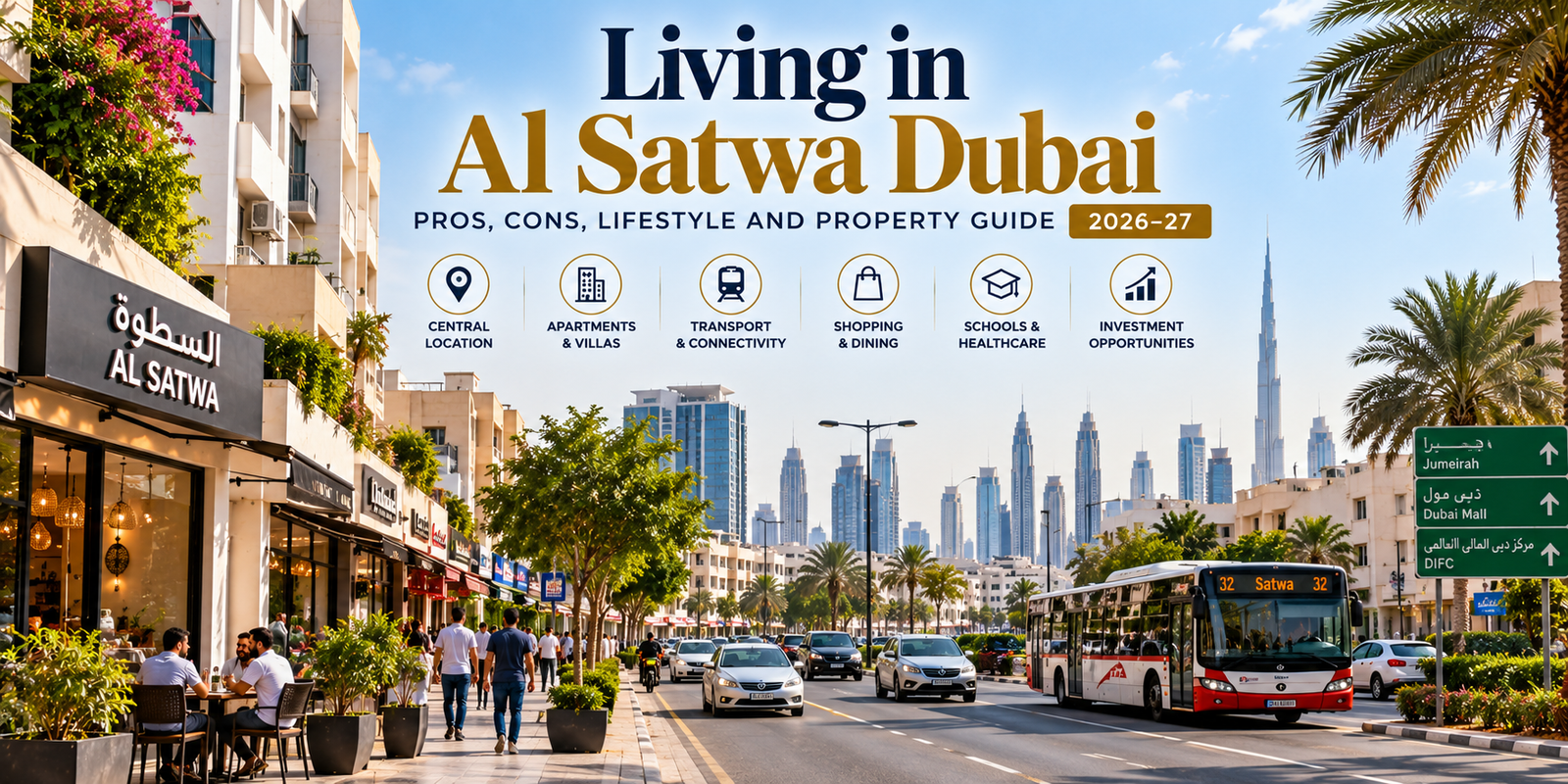
Located between Sheikh Zayed Road and Jumeirah, Al Satwa is one of Dubai’s older and more centrally positioned residential districts. It is known for its traditional low-rise buildings, busy shopping streets, tailoring businesses, independent restaurants, and diverse residential community.
Unlike newer developments built around luxury amenities and large residential towers, Al Satwa offers a more traditional urban lifestyle. At the same time, redevelopment in parts of the wider area, particularly Jumeirah Garden City, is introducing modern residential buildings and new property opportunities.
But is living in Al Satwa Dubai a good choice in 2026–27? Is it suitable for families and working professionals? Does its central location make it attractive for property investors? And what should buyers and tenants know before choosing a home here?
This guide explores Al Satwa’s location, lifestyle, residential properties, transportation, schools, healthcare, shopping, advantages, disadvantages, and investment considerations to help you decide whether this neighbourhood matches your requirements.
1. Where Is Al Satwa Located in Dubai?
Al Satwa is located in central Dubai, between the Jumeirah area and Sheikh Zayed Road. It is surrounded by established neighbourhoods and important commercial destinations, making it a convenient location for people who regularly travel across the city.
Its surrounding areas include:
- Jumeirah
- Al Badaa
- Al Wasl
- DIFC
- Downtown Dubai
- Trade Centre
- City Walk
The neighbourhood has direct connections to important roads, including Sheikh Zayed Road (E11), Al Wasl Road, and Jumeirah Beach Road.
One of Al Satwa’s biggest advantages is its position close to Dubai’s central business and lifestyle destinations without being directly inside the busiest parts of Downtown Dubai or DIFC.
The area is also closely associated with 2nd December Street, formerly known as Al Diyafah Street, which is recognised for its restaurants, shops, and local commercial activity.
According to Visit Dubai’s official Al Satwa neighbourhood guide, the district is known for its traditional streets, affordable shopping, casual dining, and distinctive local atmosphere.
2. What Is It Like Living in Al Satwa Dubai?
Living in Al Satwa offers an experience that is quite different from Dubai’s newer residential communities.
The neighbourhood combines residential buildings, small businesses, traditional shops, restaurants, workshops, and everyday services. Its streets are generally more active than those of quieter suburban communities, particularly around the main commercial roads.
One of its defining characteristics is its multicultural environment. Residents from different countries live and work in the area, contributing to its variety of restaurants, shops, and everyday experiences.
You will find traditional tailoring shops alongside supermarkets, independent cafes, pharmacies, and modern residential developments.
The wider area is also changing. Newer buildings in Jumeirah Garden City are introducing contemporary apartments and updated residential facilities while older parts of Al Satwa continue to retain their established character.
For residents, this means there is no single lifestyle experience across the entire neighbourhood. A modern apartment in a redeveloped building may offer a very different living environment from an older residential block on a busy street.
The building and exact location matter just as much as the neighbourhood itself.
3. Residential Properties in Al Satwa
Al Satwa offers a mix of traditional residential buildings and newer developments, providing different accommodation options for tenants and property buyers.
The wider area includes apartments, villas, commercial-residential buildings, and newer mid-rise developments.
Apartments for Individuals and Couples
Studio and one-bedroom apartments are common options for individuals and couples looking for a central Dubai address.
These properties may appeal to professionals working in DIFC, Downtown Dubai, Trade Centre, and surrounding business districts.
When comparing apartments, consider:
- Available floor space.
- Natural light and ventilation.
- Building maintenance.
- Air-conditioning arrangements.
- Parking availability.
- Access to supermarkets and public transport.
- Monthly rent and utility expenses.
A well-maintained apartment in a convenient location may offer a practical alternative to more expensive central residential destinations.
Larger Apartments for Families
Two-bedroom and three-bedroom apartments can suit small and medium-sized families who prefer living close to schools, healthcare facilities, shopping, and central Dubai.
However, building facilities vary. Some newer developments offer swimming pools, gyms, covered parking, and modern shared spaces, while older buildings may have fewer amenities.
Families should inspect the actual apartment and common areas rather than assuming that all buildings offer the same facilities.
Villas and Larger Residential Properties
Although Al Satwa is widely associated with apartments and low-rise buildings, the wider neighbourhood also includes villa-style residential properties.
Buyers looking for more space may want to compare Al Satwa with nearby Jumeirah and Al Badaa.
Newer Developments in Jumeirah Garden City
Jumeirah Garden City is an important part of the area’s changing residential landscape.
The district is introducing newer residential buildings and modern apartment options within the wider central Dubai location.
Some developments offer contemporary layouts, updated facilities, and ownership opportunities that differ from the traditional residential stock.
However, Al Satwa and Jumeirah Garden City should not automatically be treated as having identical ownership rules or property characteristics. Buyers must verify the exact building, plot, ownership eligibility, and title-deed details before purchasing.
4. Pros of Living in Al Satwa Dubai
Al Satwa has several advantages that make it worth considering, particularly for people who value central connectivity, everyday convenience, and a neighbourhood with established local character.
4.1 Central Location Close to Major Business Districts
Location is one of the strongest reasons people consider living in Al Satwa.
The neighbourhood provides access to several important parts of Dubai, including DIFC, Downtown Dubai, Trade Centre, Jumeirah, and City Walk.
This can be particularly useful for professionals who work in central business districts but prefer accommodation outside the most expensive prime residential locations.
Its road connections also provide access to major routes across the city.
However, actual journey times depend on traffic, the precise building location, and the time of day. Residents should test their regular commute before signing a rental agreement or purchasing a property.
4.2 Everyday Shopping and Services Within Walking Distance
Al Satwa is known for its traditional commercial streets and everyday retail facilities.
Residents can find many practical services within the neighbourhood, including:
- Supermarkets and grocery shops.
- Pharmacies.
- Tailoring and clothing shops.
- Electronics and mobile shops.
- Cafes and restaurants.
- Salons and personal-care businesses.
- Small retail outlets.
- Laundry and other household services.
This makes the area convenient for people who prefer to complete everyday errands without travelling to a large shopping mall.
The concentration of local businesses is one of the features that gives Al Satwa its distinctive identity.
4.3 A Diverse Food and Dining Scene
Food is one of Al Satwa’s most recognisable attractions.
The neighbourhood offers a wide range of casual dining options, including South Asian, Arabic, Filipino, and other international cuisines.
It is particularly popular among people who enjoy traditional eateries, affordable meals, and independent restaurants rather than only premium dining destinations.
2nd December Street is one of the area’s well-known locations for exploring its food culture.
Some established dining destinations associated with the neighbourhood include:
- Ravi Restaurant.
- Al Mallah.
- Other independent cafeterias and restaurants along the main commercial streets.
For residents, this variety provides convenient everyday dining choices and an opportunity to experience a more traditional side of Dubai.
4.4 Convenient Road Connectivity
Al Satwa benefits from its position near several important roads.
These include:
- Sheikh Zayed Road (E11).
- Al Wasl Road.
- Jumeirah Beach Road (D94).
- Other connecting roads serving the surrounding central neighbourhoods.
These connections make it possible to travel towards Downtown Dubai, DIFC, Jumeirah, Trade Centre, and other parts of the city.
People who drive regularly may find this location useful, although traffic and parking conditions should be considered.
4.5 Access to Public Transportation
Although Al Satwa does not have a Metro station within the neighbourhood itself, it is connected to Dubai’s public transport network through bus services and nearby Metro stations.
The Satwa Bus Station is an important transportation point for the area.
Visit Dubai identifies routes including F11, F12, 88, and 32C among the services connecting Al Satwa with other parts of the city. Routes and schedules can change, so residents should check current information through the RTA.
The nearby Financial Centre and World Trade Centre Metro stations can provide additional access to the Dubai Metro network, depending on the exact starting point.
Official information: Dubai Roads and Transport Authority.
4.6 Close to Jumeirah Beaches and Outdoor Attractions
Another advantage of Al Satwa is its proximity to the Jumeirah coastline and several popular lifestyle destinations.
Residents can explore nearby attractions such as:
- J1 Beach.
- Jumeirah Beach.
- City Walk.
- La Mer’s wider coastal district.
- Al Khazzan Park.
- Other recreational spaces in central Dubai.
These destinations provide opportunities for outdoor activities, dining, shopping, and weekend outings.
The exact travel distance depends on the building and traffic conditions, so check the route before choosing a property.
4.7 More Traditional Neighbourhood Character
Al Satwa offers something that can be difficult to find in Dubai’s newer master-planned communities: a strong traditional neighbourhood atmosphere.
Its independent businesses, established streets, multicultural population, and local restaurants contribute to its identity.
Residents who enjoy neighbourhood shopping and casual dining may appreciate this environment more than communities dominated by large residential towers and commercial malls.
4.8 Modern Residential Options in Redevelopment Areas
The redevelopment of parts of the wider area, particularly Jumeirah Garden City, is introducing newer apartment buildings.
These developments may offer:
- Contemporary apartment layouts.
- Modern building facilities.
- Covered parking.
- Updated residential interiors.
- Shared swimming pools and fitness facilities in selected buildings.
- Different ownership opportunities, depending on the property.
For tenants and buyers who want a central location with more modern accommodation, these developments are worth comparing with traditional Al Satwa buildings.
5. Cons of Living in Al Satwa Dubai
Despite its central location and everyday convenience, Al Satwa has several limitations.
Understanding these disadvantages can help you decide whether the neighbourhood suits your lifestyle.
5.1 Older Buildings and Differences in Property Quality
Al Satwa contains many older residential buildings, and their condition can vary significantly.
Some buildings may offer basic facilities without the modern features available in newer residential communities.
Potential issues to check include:
- Age and condition of the building.
- Lift maintenance.
- Plumbing and electrical systems.
- Air-conditioning performance.
- Water leakage and dampness.
- Common-area cleanliness.
- Noise insulation.
- Parking facilities.
If you are renting, inspect the apartment carefully before signing.
If you are buying, consider arranging a professional property inspection where appropriate.
Do not assume that a building is in good condition simply because its apartment has recently been renovated.
5.2 Parking Can Be Difficult
Parking is an important consideration in Al Satwa.
Some older buildings have limited parking facilities, while street parking around busy commercial roads can become difficult, especially during evenings and weekends.
Residents who own a car should confirm whether an apartment comes with a dedicated parking space.
Before renting or purchasing, check:
- Whether parking is allocated to the unit.
- Whether the parking space is covered.
- Visitor parking availability.
- Any additional parking charges.
- Whether parking arrangements are included in the contract.
People who frequently receive visitors should pay particular attention to this issue.
5.3 Busy Streets and Traffic Noise
Al Satwa is a mixed-use neighbourhood with residential buildings, shops, workshops, and restaurants operating close to one another.
As a result, some streets can become busy throughout the day.
Traffic, deliveries, commercial activity, and evening dining crowds may create additional noise around certain buildings.
If you prefer a quiet residential environment, pay attention to the apartment’s position.
A unit facing an internal courtyard or quieter street may offer a different experience from one facing a busy commercial road.
Visit the property during the day and evening before making your decision.
5.4 No Metro Station Inside Al Satwa
One of the area’s main transportation limitations is the absence of a Metro station within Al Satwa itself.
Residents who use the Metro daily may need to walk, take a bus, or use a taxi to reach the nearest suitable station.
The convenience of the Metro therefore depends on the exact building location and the connection available.
For people who commute by public transport, this should be checked before signing a lease.
5.5 Limited Resort-Style Residential Amenities
Al Satwa’s traditional residential buildings do not necessarily offer the same lifestyle facilities found in newer master-planned communities.
Some older buildings may not have:
- Swimming pools.
- Modern fitness centres.
- Landscaped podiums.
- Children’s play areas.
- Community lounges.
- Dedicated recreational spaces.
Newer buildings in the wider redevelopment area may offer some of these features, but availability varies.
If building amenities are important to you, compare individual developments rather than choosing based only on the neighbourhood.
5.6 Ongoing Redevelopment and Construction Activity
Redevelopment can improve the residential appeal of an area, but construction activity may create temporary inconvenience.
Depending on the location, residents may experience:
- Construction noise.
- Dust.
- Temporary road changes.
- Heavy construction vehicles.
- Changes in nearby views.
- Temporary parking pressure.
Buyers should also research the redevelopment status of older properties before purchasing.
Ask about relevant building notices, ownership arrangements, and any planned changes that could affect the property.
5.7 Less Suitable for People Seeking a Quiet Suburban Lifestyle
Al Satwa’s central location and mixed-use environment create an active neighbourhood atmosphere.
People who prefer large landscaped parks, quiet residential streets, private gardens, and extensive community facilities may find some other Dubai communities more suitable.
Areas such as Dubai Hills Estate, Arabian Ranches, and parts of Jumeirah offer different residential environments.
The right choice depends on whether you prioritise central convenience or a quieter suburban lifestyle.
6. Transportation and Connectivity in Al Satwa
Transportation is an important part of daily life, particularly for people working in central Dubai.
Al Satwa offers road access and bus connections, although the absence of a Metro station within the neighbourhood means that some residents need an additional connection to reach the rail network.
Major Roads
The neighbourhood is connected to several major routes, including:
Sheikh Zayed Road: Provides access to DIFC, Trade Centre, Business Bay, and other parts of Dubai.
Al Wasl Road: Connects Al Satwa with surrounding residential areas.
Jumeirah Beach Road: Provides access towards the Jumeirah coastline and nearby lifestyle destinations.
Public Bus Services
Satwa Bus Station serves as an important public transport hub.
Visit Dubai identifies services such as F11, F12, 88, and 32C as routes connecting the neighbourhood with other parts of the city.
However, route availability, stops, and schedules may change.
Check the latest information using the RTA Journey Planner.
Metro Connectivity
There is no Metro station within Al Satwa itself.
Depending on the building, residents may use Financial Centre, World Trade Centre, or another suitable station through a connecting bus, taxi, or private vehicle.
If you rely on public transport, calculate the complete journey rather than considering only the distance to the nearest station.
Taxis and Ride-Hailing Services
Taxis and ride-hailing services provide additional transportation options.
These can be useful for residents who do not own a vehicle or who need to reach destinations not directly served by their usual bus route.
However, frequent taxi journeys can increase monthly living expenses.
7. Schools and Education Near Al Satwa
Families considering Al Satwa should research the schools available in the surrounding central Dubai neighbourhoods.
The wider area provides access to educational institutions in Jumeirah, Al Wasl, and other nearby communities.
Schools that parents may want to research include:
- Jumeira Baccalaureate School.
- Jumeirah English Speaking School.
- Horizon English School.
- Other schools in the surrounding Jumeirah and central Dubai districts.
School suitability depends on the child’s age, curriculum preference, admission availability, fees, and daily travel requirements.
Parents should check the latest school information and inspection reports through the Knowledge and Human Development Authority (KHDA).
Before choosing an apartment, calculate the school journey during morning peak hours.
A school that appears nearby on a map may still require additional travel time due to traffic.
8. Healthcare Facilities Near Al Satwa
Healthcare accessibility is another important factor when choosing a residential location.
Al Satwa and its surrounding central neighbourhoods have access to clinics, pharmacies, medical centres, and hospitals.
Residents can research healthcare providers in nearby areas such as Jumeirah, Trade Centre, and DIFC.
Facilities to consider include:
- Medcare Hospital and medical centres in the surrounding area.
- Emirates Hospital Jumeirah.
- Other clinics and healthcare centres serving central Dubai.
Availability of services, specialist departments, and insurance acceptance should be confirmed directly with the healthcare provider.
For families, people with regular medical appointments, and older residents, it is worth checking the location of the nearest suitable facility before moving.
9. Shopping, Restaurants and Lifestyle in Al Satwa
Shopping and dining are among the strongest lifestyle features of Al Satwa.
The neighbourhood has a well-established retail environment with traditional businesses, supermarkets, small shops, and independent restaurants.
Everyday Shopping
Residents can find groceries, household products, pharmacies, tailoring services, and other everyday facilities along the main commercial streets.
This makes the neighbourhood convenient for people who prefer local shopping instead of travelling to a large mall for every requirement.
2nd December Street
2nd December Street is one of the area’s best-known commercial and dining destinations.
It offers a variety of restaurants and shops and is a good place to experience Al Satwa’s local character.
City Walk
City Walk is a nearby lifestyle and retail destination offering restaurants, shopping, cafes, entertainment, and leisure facilities.
Official website: City Walk Dubai.
Dubai Mall
Dubai Mall is another major shopping and entertainment destination within central Dubai.
It offers an extensive selection of retail outlets, dining venues, and attractions.
Official website: Dubai Mall.
Jumeirah Beaches
Residents can also travel towards the Jumeirah coastline for beach activities, restaurants, and outdoor leisure.
This adds another lifestyle advantage for people who enjoy spending time near the sea.
10. Parks and Outdoor Activities Near Al Satwa
Although Al Satwa is a dense urban neighbourhood, residents have access to outdoor spaces and recreational destinations in the surrounding area.
Al Khazzan Park
Al Khazzan Park is a small urban park located near the Al Satwa and City Walk area.
It offers an outdoor space for residents looking for a short break from busy city streets.
Satwa Park
Satwa Park is another green space associated with the neighbourhood. Residents should check current access, facilities, and operating arrangements before planning a visit.
Jumeirah Beach
Jumeirah Beach offers opportunities for swimming, walking, and enjoying the coastline.
It is particularly useful for residents who want outdoor leisure without travelling to distant parts of Dubai.
City Walk
City Walk offers pedestrian-friendly outdoor spaces, cafes, restaurants, and shopping facilities.
It is a convenient destination for residents looking for a more contemporary lifestyle environment close to Al Satwa.
11. Is Al Satwa a Good Place for Families?
Al Satwa can be suitable for families who prefer central living and want access to everyday shopping, healthcare, schools, and surrounding lifestyle facilities.
However, the suitability of the area depends heavily on the chosen building.
Families should evaluate:
- Availability of two- or three-bedroom apartments.
- Building maintenance and safety.
- Dedicated parking.
- Access to schools.
- Nearby healthcare facilities.
- Children’s play areas.
- Noise levels.
- Outdoor recreational spaces.
- Monthly rent and utility expenses.
Families who prefer large community parks, swimming pools, private gardens, and quieter streets may want to compare Al Satwa with nearby suburban communities.
For families who value a central address and practical everyday convenience, however, selected residential buildings in Al Satwa may be worth considering.
12. Is Al Satwa a Good Place for Working Professionals?
Al Satwa can be a practical residential choice for working professionals because of its central location and access to major business districts.
It may be particularly convenient for people employed in:
- DIFC.
- Downtown Dubai.
- Trade Centre.
- Business Bay.
- Jumeirah.
- Surrounding commercial areas.
Professionals who work in these locations may be able to reduce their commuting distance compared with living in more distant residential communities.
The area may also appeal to people who prefer independent restaurants, local shopping, and a multicultural neighbourhood environment.
However, residents who require a Metro station directly outside their building or prefer modern resort-style amenities should compare other locations before deciding.
13. Is Al Satwa a Good Place to Invest in Property?
Al Satwa may attract property investors because of its central location, established residential demand, and redevelopment activity in parts of the wider area.
The introduction of newer residential buildings in Jumeirah Garden City is also creating additional property options for buyers.
However, investment opportunities should be evaluated at the building and unit level.
Central Location and Residential Demand
Al Satwa’s proximity to DIFC, Downtown Dubai, Jumeirah, and Trade Centre can make it relevant to professionals looking for central accommodation.
This may support demand for suitably priced apartments, although actual rental performance varies by building and market conditions.
Newer Residential Developments
Redevelopment areas offer buyers the opportunity to compare modern apartments with older residential stock.
Newer buildings may provide updated facilities, layouts, and building services.
However, buyers should check the exact location and ownership status rather than assuming that every property in Al Satwa or the surrounding area has the same investment characteristics.
Rental Income and Operating Expenses
Before buying an apartment for rental income, research comparable properties and actual rental transactions.
Calculate:
- Expected annual rent.
- Purchase price.
- DLD registration fees.
- Agency and registration expenses.
- Service charges.
- Maintenance.
- Property management.
- Vacancy periods.
- Furnishing costs, where applicable.
For example, a property with a lower purchase price may still generate a weaker net return if maintenance expenses and service charges are high.
Do not rely solely on advertised rental yields.
Verify Freehold Ownership Before Buying
This is particularly important in Al Satwa because the neighbourhood contains different property types and ownership arrangements.
Some newer developments in Jumeirah Garden City offer freehold ownership, but this should never be assumed for every property in Al Satwa.
Before paying a deposit, verify:
- The property’s title-deed details.
- The land or plot identification.
- The ownership eligibility for foreign buyers.
- Any restrictions affecting the specific building.
- Whether the property is eligible for the intended ownership structure.
Use the Dubai Land Department and independent professional advice to verify the details.
Consider Redevelopment Risk
Redevelopment may introduce modern buildings and improve parts of the wider area, but it can also create uncertainty for certain older properties.
Buyers should understand the property’s legal status, building condition, future plans, and any relevant notices before purchasing.
For a long-term investment, the quality of the individual property is more important than relying on a general prediction about neighbourhood growth.
14. Al Satwa vs Nearby Residential Areas
If you are considering Al Satwa, comparing it with nearby communities can help identify the right lifestyle and budget.
| Community | Lifestyle | Main consideration |
|---|---|---|
| Al Satwa | Traditional, central, mixed-use | Local shopping, central access, varied building quality |
| Jumeirah | Established residential and coastal | Villas, lifestyle facilities, and premium residential options |
| DIFC | Premium business and urban lifestyle | Offices, dining, modern residential towers, higher price positioning |
| Downtown Dubai | Luxury urban living | Major attractions, premium apartments, shopping, and entertainment |
| City Walk | Contemporary mixed-use lifestyle | Retail, dining, apartments, and pedestrian-friendly spaces |
| Al Badaa | Established residential neighbourhood | Central location and traditional residential character |
Al Satwa vs Jumeirah
Jumeirah is known for its established residential environment, villas, beach access, and lifestyle facilities.
Al Satwa offers a denser and more commercially active environment with traditional shops, restaurants, and a mix of older and newer buildings.
Al Satwa vs DIFC
DIFC offers a premium business and residential environment with modern towers, restaurants, and offices.
Al Satwa may appeal to people who want to remain close to DIFC without necessarily choosing a home inside the business district.
Al Satwa vs Downtown Dubai
Downtown Dubai is known for luxury residential towers, shopping, attractions, and a more tourism-focused lifestyle.
Al Satwa provides a more traditional neighbourhood atmosphere and a different mix of residential properties and everyday services.
The right choice depends on your budget, commuting needs, and preferred lifestyle.
15. Who Should Consider Living in Al Satwa?
Al Satwa may be suitable for:
Working professionals: Particularly those employed in DIFC, Downtown Dubai, Trade Centre, and nearby commercial areas.
Young couples: People looking for a central residential location with access to everyday shopping and restaurants.
Budget-conscious residents: Tenants who want to compare accommodation options outside some of Dubai’s more expensive prime districts.
Long-term Dubai residents: People who appreciate traditional neighbourhoods and a diverse local environment.
Property investors: Buyers interested in selected newer residential developments and the wider redevelopment opportunity.
It may be less suitable for people who want a very quiet suburban environment, guaranteed parking in every building, extensive resort-style amenities, or a Metro station immediately outside their home.
16. Things to Check Before Renting or Buying in Al Satwa
Before selecting a property, take time to inspect the actual building and surrounding streets.
Use this checklist to make a more informed decision.
-
Visit the property during the day and evening.
-
Check the building’s maintenance and cleanliness.
-
Test the air conditioning and ventilation.
-
Inspect bathrooms, plumbing, and signs of dampness.
-
Confirm whether dedicated parking is included.
-
Check nearby construction and redevelopment activity.
-
Evaluate street noise and traffic.
-
Check the walking distance to supermarkets and bus stops.
-
Calculate your commute during peak hours.
-
Confirm school and healthcare access if relevant.
-
Compare service charges and maintenance expenses.
-
Verify the ownership status if purchasing.
-
Review the tenancy contract or SPA before signing.
For property buyers, it is especially important to verify title-deed information and ownership eligibility independently.
For tenants, confirm all rental terms, parking arrangements, maintenance responsibilities, and Ejari registration requirements in writing.
Frequently Asked Questions About Living in Al Satwa Dubai
1. Is Al Satwa a good place to live in Dubai?
Al Satwa can be a good residential choice for people who value a central location, local shopping, diverse restaurants, and access to nearby business districts. However, building quality, parking, noise, and public transportation should be considered before moving.
2. Where is Al Satwa located in Dubai?
Al Satwa is located in central Dubai between Sheikh Zayed Road and Jumeirah. It is close to DIFC, Downtown Dubai, City Walk, Al Wasl, and other established neighbourhoods.
3. Is Al Satwa cheaper than Downtown Dubai?
Al Satwa generally offers different and often more budget-conscious residential options than Downtown Dubai. However, prices vary considerably between older buildings and newer developments. Compare current rents and completed property transactions rather than relying on general averages.
4. Does Al Satwa have a Metro station?
No. Al Satwa does not have a Metro station within the neighbourhood. Residents can use buses, taxis, or private vehicles to connect with nearby Metro stations.
5. Which bus services connect Al Satwa to other parts of Dubai?
Visit Dubai identifies routes such as F11, F12, 88, and 32C among the services connecting Al Satwa with other areas. Check the RTA website for current routes and schedules.
6. Is Al Satwa suitable for families?
It can be suitable for families who want central living and access to nearby schools, healthcare, shopping, and everyday services. Families should carefully evaluate apartment size, parking, building facilities, and school journeys.
7. Are there modern apartments in Al Satwa?
Yes. Newer residential developments in the wider Jumeirah Garden City area provide modern apartment options. However, the neighbourhood also contains many older buildings, so property quality and facilities vary.
8. Can foreigners buy property in Al Satwa?
Foreign ownership depends on the specific property and whether it is located in an area designated for the intended ownership structure. Some newer developments in Jumeirah Garden City offer freehold opportunities, but buyers must verify each property’s eligibility through official records before paying.
9. Is Al Satwa good for property investment?
It may be worth considering because of its central location, residential demand, and redevelopment activity. However, returns depend on purchase price, rental demand, service charges, building quality, ownership status, and market conditions.
10. What are the main disadvantages of living in Al Satwa?
Common considerations include older buildings, limited parking in some locations, busy streets, traffic noise, the absence of a Metro station within the neighbourhood, and fewer modern amenities in certain traditional buildings.
11. Is Al Satwa close to the beach?
Al Satwa is relatively close to the Jumeirah coastline. Residents can travel to nearby beach destinations such as Jumeirah Beach and J1 Beach, although journey times depend on traffic and the exact starting location.
12. Is Al Satwa a good place for professionals working in DIFC?
It can be a practical option for professionals working in DIFC because of its central location and road connections. However, commute times should be tested during working hours, and residents relying on the Metro should consider the additional connection required.
Final Verdict: Should You Choose Al Satwa Dubai?
Al Satwa offers a different residential experience from Dubai’s newer luxury communities. Its central location, traditional shopping streets, diverse food scene, and access to business districts make it an interesting option for people who prioritise convenience and neighbourhood character.
The area also presents opportunities for buyers interested in newer residential developments in the wider Jumeirah Garden City redevelopment zone.
However, the neighbourhood is not without its limitations. Older buildings, parking challenges, traffic noise, and the lack of an internal Metro station may influence the daily experience.
The most important step is to evaluate the specific property rather than making a decision based only on the neighbourhood’s name.
For tenants, check building maintenance, parking, noise, and commuting requirements. For buyers, verify ownership eligibility, compare service charges, and assess the property’s long-term rental potential.
At DubaiLuxuryDeals, explore Dubai’s residential neighbourhoods and property opportunities to find a location that matches your lifestyle, budget, and investment objectives.
Disclaimer: This article is intended for general educational and informational purposes only. It does not constitute legal, financial, tax, or investment advice. Property prices, rental values, ownership eligibility, transportation routes, and community facilities may change. Verify current information with the relevant official authorities, property owners, developers, and qualified real estate professionals before making a rental or purchase decision.
