
Dubai’s real estate market continues to attract investors from around the world thanks to its tax-friendly environment, strong rental yields, world-class infrastructure, and investor-focused regulations. Whether you’re buying a luxury villa, waterfront apartment, penthouse, or investment property, one document plays a critical role before ownership transfer—the Memorandum of Understanding (MOU).
Many first-time buyers hear terms such as “Form F,” “MOU,” “purchase agreement,” or “property deposit agreement” without fully understanding their significance.
In this comprehensive guide, we’ll explain what an MOU is, why it matters, what it contains, how the signing process works, and the common mistakes investors should avoid when buying property in Dubai.
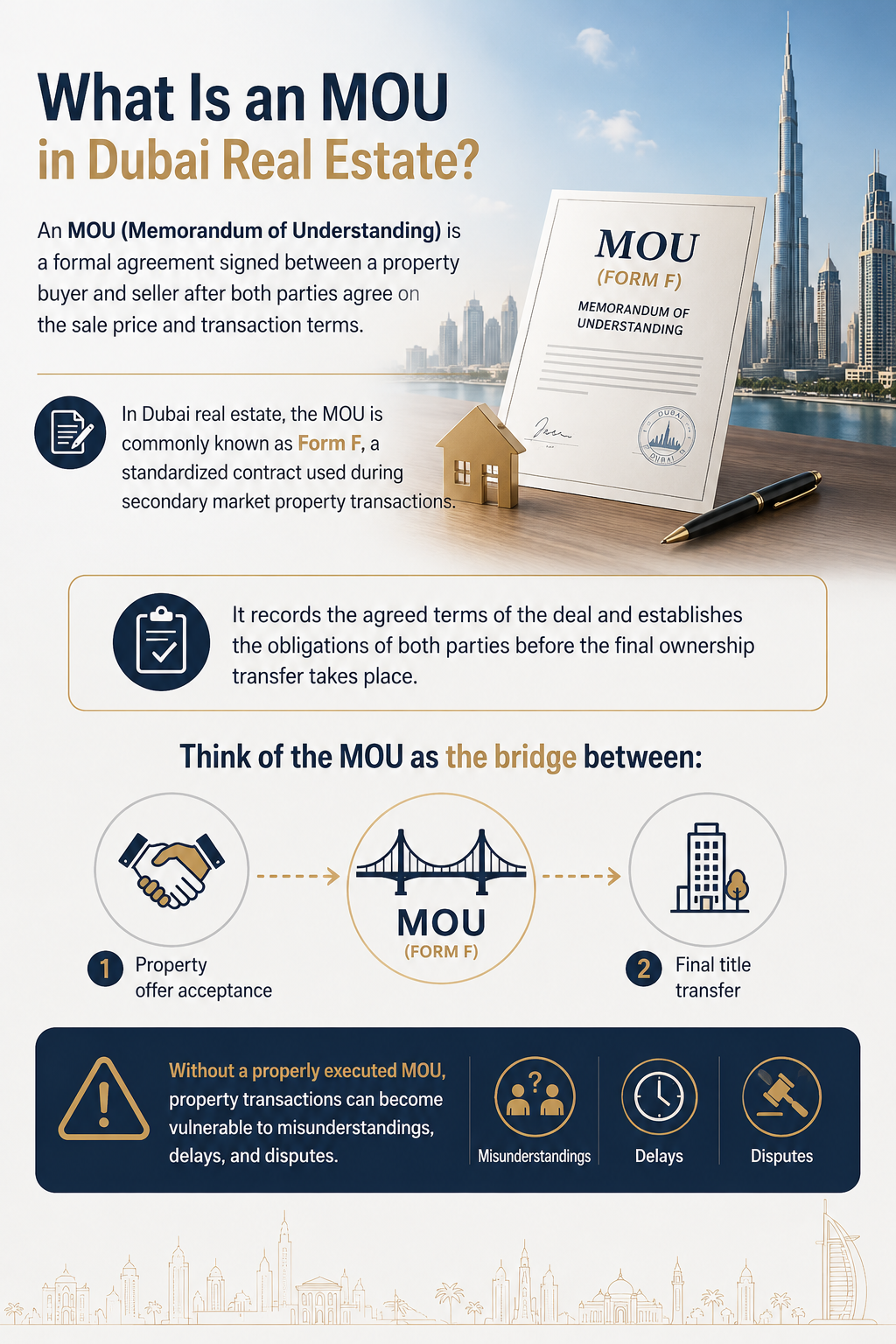
What Is an MOU in Dubai Real Estate?
An MOU (Memorandum of Understanding) is a formal agreement signed between a property buyer and seller after both parties agree on the sale price and transaction terms.
In Dubai real estate, the MOU is commonly known as Form F, a standardized contract used during secondary market property transactions. It records the agreed terms of the deal and establishes the obligations of both parties before the final ownership transfer takes place.
Think of the MOU as the bridge between:
- Property offer acceptance
- Final title transfer
Without a properly executed MOU, property transactions can become vulnerable to misunderstandings, delays, and disputes.
Why Is the MOU So Important?
The MOU serves several important purposes for both buyers and sellers.
Protects Both Parties
Once signed, the document records the agreed purchase price, timelines, responsibilities, and payment terms, reducing the risk of unexpected changes.
Establishes Commitment
The MOU demonstrates serious intent from both parties and helps move the transaction toward completion.
Creates Transaction Transparency
Every major aspect of the deal is documented, creating clarity and accountability throughout the process.
Supports Legal Protection
The agreement provides a framework for handling defaults, delays, cancellations, and disputes if they arise.
When Is an MOU Signed?
The MOU is usually signed after:
- Buyer identifies a property.
- Seller accepts the offer.
- Both parties agree on terms.
- Financing arrangements are reviewed.
- Deposit requirements are discussed.
Only after these steps are completed does the transaction move into the MOU stage.
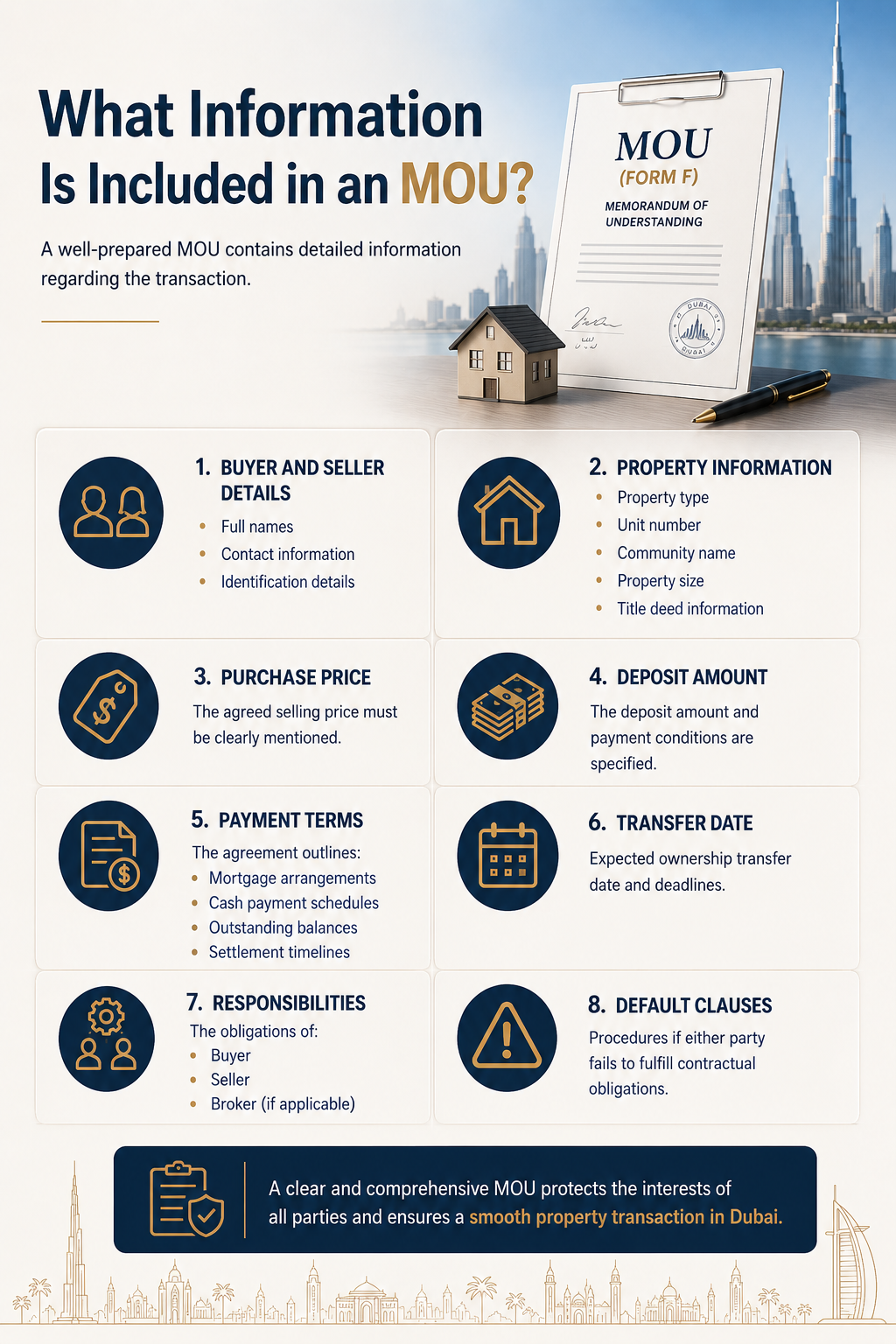
What Information Is Included in an MOU?
A well-prepared MOU contains detailed information regarding the transaction.
Buyer and Seller Details
- Full names
- Contact information
- Identification details
Property Information
- Property type
- Unit number
- Community name
- Property size
- Title deed information
Purchase Price
The agreed selling price must be clearly mentioned.
Deposit Amount
The deposit amount and payment conditions are specified.
Payment Terms
The agreement outlines:
- Mortgage arrangements
- Cash payment schedules
- Outstanding balances
- Settlement timelines
Transfer Date
Expected ownership transfer date and deadlines.
Responsibilities
The obligations of:
- Buyer
- Seller
- Broker (if applicable)
Default Clauses
Procedures if either party fails to fulfill contractual obligations.
Understanding the 10% Deposit
One of the most discussed aspects of the MOU is the deposit.
In many Dubai property transactions, buyers provide a deposit equal to approximately 10% of the agreed property value when signing Form F. The deposit serves as evidence of commitment and helps secure the transaction.
The deposit is generally:
- Held securely until transfer completion
- Released according to agreed contract terms
- Subject to conditions outlined in the MOU
Buyers should carefully understand the circumstances under which the deposit may be refunded or forfeited.
MOU vs Sales and Purchase Agreement (SPA)
Many investors confuse an MOU with a Sales and Purchase Agreement (SPA).
| MOU (Form F) | SPA |
|---|---|
| Initial binding transaction agreement | Final sale contract |
| Used before ownership transfer | Governs the completed sale |
| Establishes key terms | Formalizes complete ownership transfer |
| Usually signed after offer acceptance | Signed as part of final transaction process |
Both documents are important but serve different stages of the transaction journey.
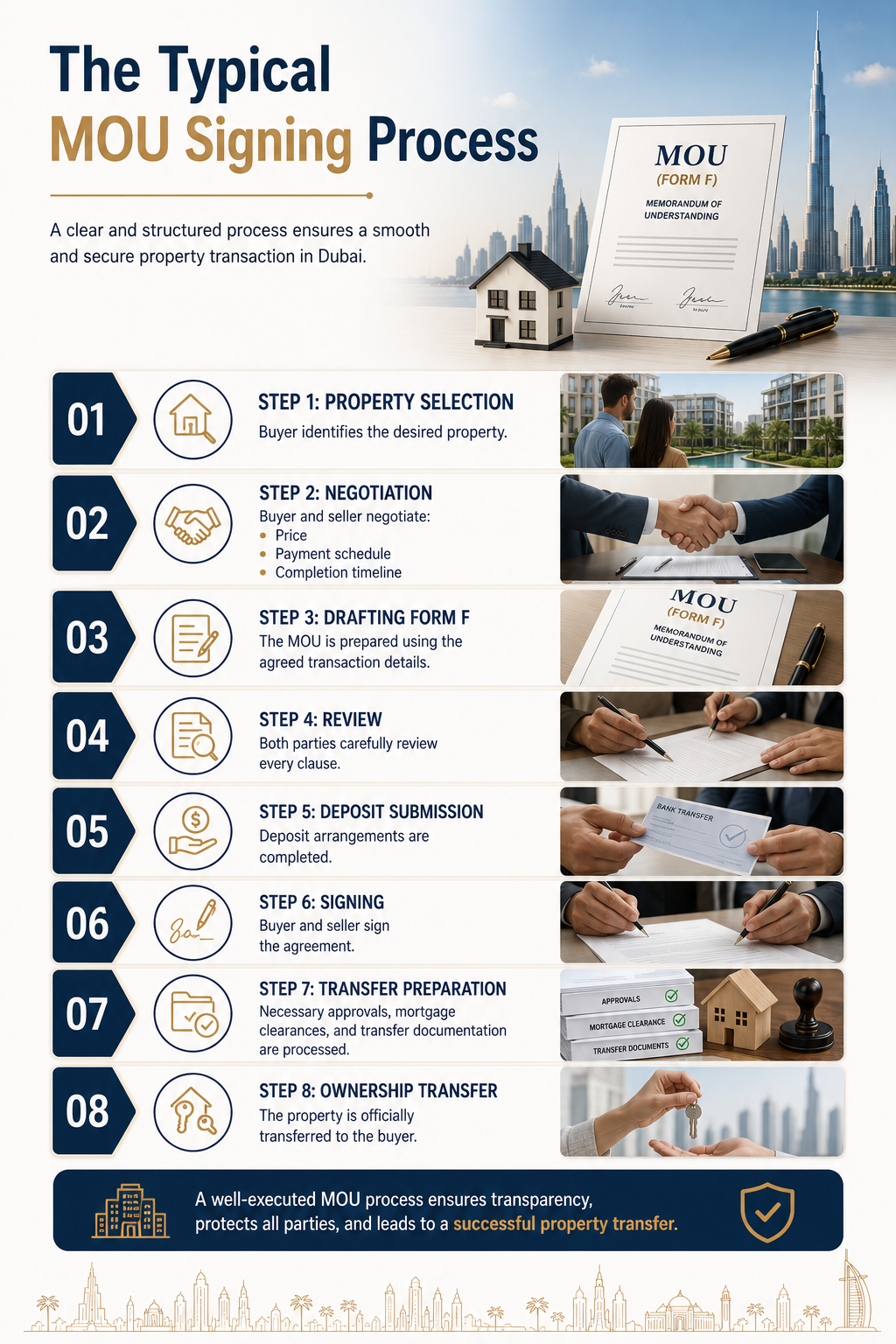
The Typical MOU Signing Process
Step 1: Property Selection
Buyer identifies the desired property.
Step 2: Negotiation
Buyer and seller negotiate:
- Price
- Payment schedule
- Completion timeline
Step 3: Drafting Form F
The MOU is prepared using the agreed transaction details.
Step 4: Review
Both parties carefully review every clause.
Step 5: Deposit Submission
Deposit arrangements are completed.
Step 6: Signing
Buyer and seller sign the agreement.
Step 7: Transfer Preparation
Necessary approvals, mortgage clearances, and transfer documentation are processed.
Step 8: Ownership Transfer
The property is officially transferred to the buyer.
Key Clauses Every Buyer Should Review Carefully
Before signing, investors should pay special attention to the following sections.
Purchase Price
Ensure the agreed amount matches all previous negotiations.
Deposit Conditions
Understand:
- Refund rules
- Forfeiture scenarios
- Deposit handling procedures
Completion Timeline
Verify the expected transfer date.
Property Condition
Confirm the property is free from undisclosed issues.
Outstanding Liabilities
Check for:
- Service charges
- Mortgages
- Developer dues
Penalties
Review consequences of non-performance by either party.
Common Mistakes Investors Make
Signing Without Legal Review
Always understand every clause before signing.
Ignoring Deposit Terms
Many disputes arise because buyers misunderstand deposit conditions.
Not Verifying Ownership
Ensure the seller has legal authority to sell the property.
Overlooking Hidden Costs
Account for:
- Transfer fees
- Registration fees
- Service charges
- Mortgage-related costs
Rushing the Process
Luxury property purchases deserve proper due diligence.
Why International Investors Should Pay Attention to the MOU
Dubai remains one of the world’s most attractive property investment destinations. Even amid evolving market conditions, the emirate continues introducing measures that improve transparency, investor confidence, and transaction efficiency. Recent initiatives by government authorities further streamline property-related services and strengthen the investment ecosystem.
For international investors, the MOU serves as an essential safeguard that clearly defines rights, obligations, and expectations before significant capital is committed.
How Dubai Luxury Deals Helps Buyers Navigate the MOU Process
At Dubai Luxury Deals, we help investors make informed property decisions across Dubai’s luxury and off-plan real estate market.
Our team assists clients with:
- Property selection
- Market analysis
- Transaction guidance
- MOU review support
- Developer comparisons
- Investment strategy
- End-to-end buying assistance
Whether you’re purchasing a waterfront apartment, branded residence, villa, or investment property, understanding the MOU process can help ensure a smoother and more secure transaction.
Frequently Asked Questions (FAQs)
Is an MOU legally binding in Dubai real estate?
In Dubai property transactions, Form F (MOU) is generally treated as the formal agreement that records the final terms accepted by both buyer and seller before ownership transfer.
What is Form F?
Form F is the standardized Dubai property transaction agreement used to document the agreed terms between buyer and seller.
Is the deposit always 10%?
While 10% is common market practice, the actual amount can vary depending on the negotiated agreement between buyer and seller.
Can a property deal be canceled after signing the MOU?
Cancellation depends on the terms specified within the agreement and the circumstances surrounding the transaction. Deposit consequences may apply.
Should foreign investors review the MOU carefully?
Absolutely. International buyers should fully understand all obligations, timelines, fees, and default clauses before signing any property agreement.
Final Thoughts
A Memorandum of Understanding (MOU) is one of the most important documents in a Dubai property transaction. It establishes the foundation of the deal, protects both parties, records agreed terms, and helps move the transaction toward a successful ownership transfer.
For investors seeking luxury apartments, waterfront residences, branded properties, or high-return investment opportunities in Dubai, understanding the MOU process is an essential step toward making a confident and informed purchase.
