
Dubai continues to attract global investors, expatriates, and luxury homebuyers looking to secure premium real estate in one of the world’s fastest-growing property markets. With attractive payment plans, strong rental yields, and expanding freehold communities, many buyers are now exploring mortgage financing as a practical way to purchase property in Dubai.
Understanding mortgage eligibility in Dubai is one of the most important steps before beginning your property search. Whether you’re an end-user purchasing a dream home or an investor building a portfolio, knowing how banks assess your eligibility can save time, improve approval chances, and help you choose the right property.
This guide explains everything you need to know about mortgage eligibility in Dubai in 2026.
Why Mortgage Eligibility Matters
Mortgage eligibility determines how much a bank is willing to lend based on your financial profile.
Before approving a home loan, lenders evaluate factors such as:
- Monthly income
- Employment status
- Credit score
- Existing liabilities
- Residency status
- Age
- Property value
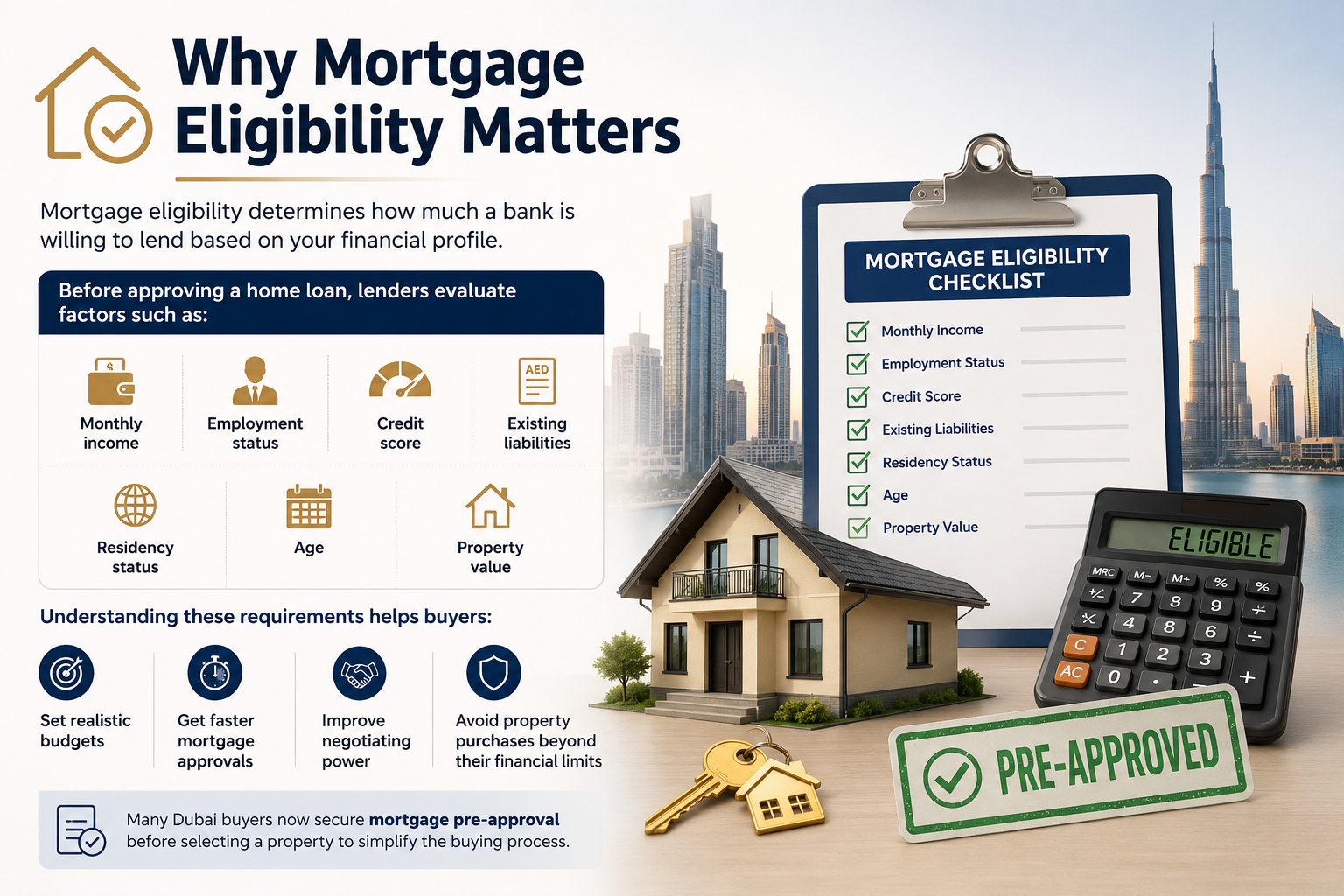
Understanding these requirements helps buyers:
- Set realistic budgets
- Get faster mortgage approvals
- Improve negotiating power
- Avoid property purchases beyond their financial limits
Many Dubai buyers now secure mortgage pre-approval before selecting a property to simplify the buying process.
Can Expats Get a Mortgage in Dubai?
Yes.
Dubai allows both UAE residents and non-residents to purchase property and obtain mortgage financing through local and international banks.
Most major UAE lenders offer mortgage products specifically designed for:
- Resident expatriates
- Self-employed professionals
- Business owners
- Foreign investors
- Non-resident buyers
Several banks provide financing of up to 80% of the property’s value for eligible resident expatriates.
Basic Mortgage Eligibility Requirements in Dubai
Minimum Age Requirement
Most banks require applicants to be:
- At least 21 years old
- Maximum age between 65 and 70 at loan maturity depending on employment type and lender policies.
Stable Income
Income stability remains one of the biggest factors affecting mortgage approval.
Banks generally prefer applicants who have:
- Regular monthly income
- Stable employment history
- Consistent bank statements
- Verifiable salary transfers
Many lenders commonly require monthly salaries starting from AED 10,000–15,000, although requirements vary by bank.
Employment Status
Both salaried and self-employed applicants can qualify.
Salaried Applicants Usually Need:
- Passport
- Visa copy
- Emirates ID
- Salary certificate
- Recent payslips
- Bank statements
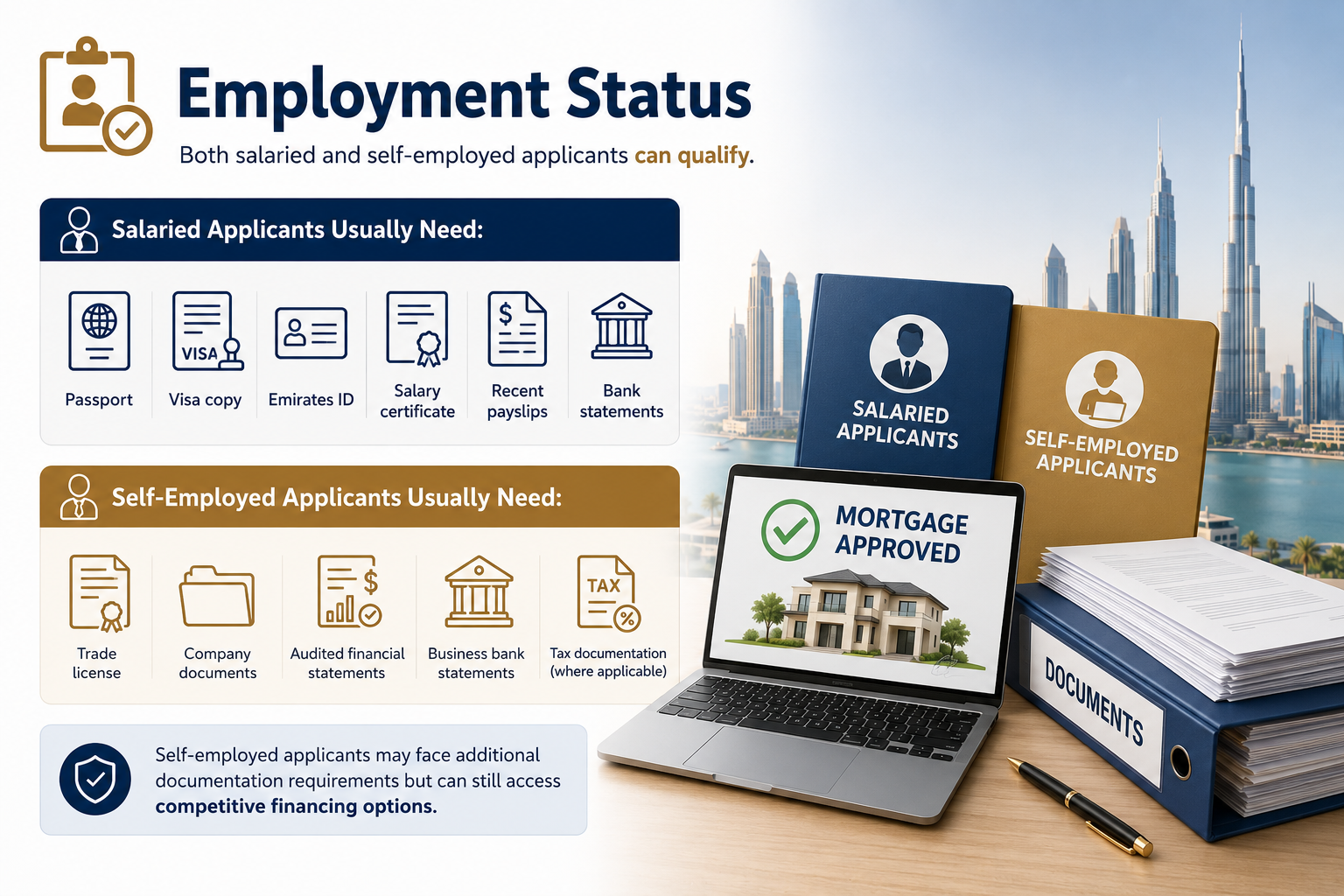
Self-Employed Applicants Usually Need:
- Trade license
- Company documents
- Audited financial statements
- Business bank statements
- Tax documentation (where applicable)
Self-employed applicants may face additional documentation requirements but can still access competitive financing options.
Credit Score and Financial History
Your credit profile plays a major role in determining:
- Approval chances
- Interest rates
- Loan amount eligibility
Banks review:
- Credit bureau reports
- Existing loans
- Credit card balances
- Payment history
A strong credit profile generally improves approval chances and may help secure better interest rates.
Debt Burden Ratio (DBR)
The UAE Central Bank requires lenders to assess an applicant’s Debt Burden Ratio (DBR).
This measures how much of your monthly income is already committed to financial obligations.
These may include:
- Personal loans
- Car loans
- Credit card liabilities
- Existing mortgages
In most cases, total monthly obligations should not exceed approximately 50% of monthly income.
For example:
- Monthly income: AED 30,000
- Maximum debt obligations: Around AED 15,000
Maintaining a lower DBR improves borrowing capacity.
Down Payment Requirements in Dubai
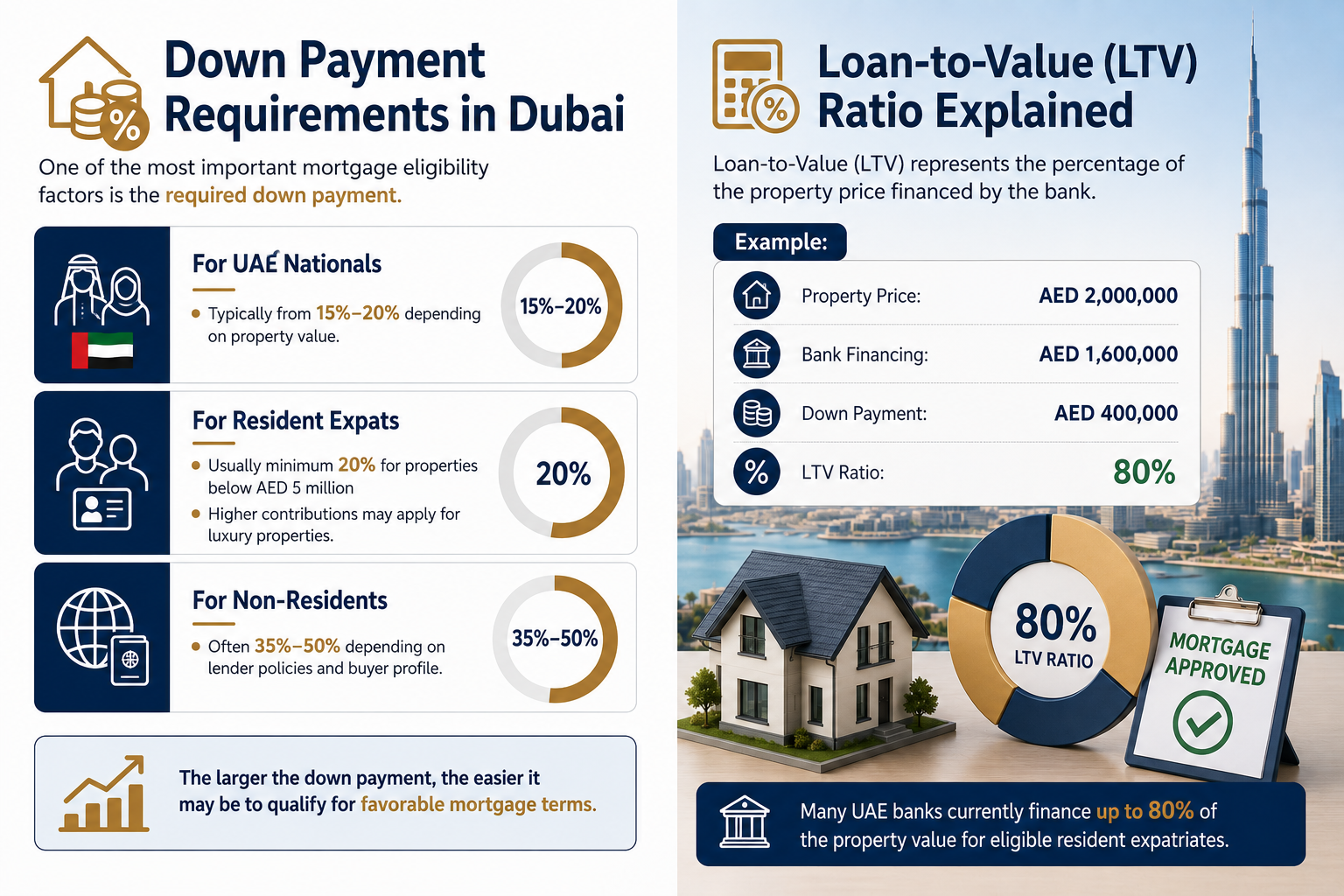
One of the most important mortgage eligibility factors is the required down payment.
For UAE Nationals
- Typically from 15%–20% depending on property value.
For Resident Expats
- Usually minimum 20% for properties below AED 5 million
- Higher contributions may apply for luxury properties.
For Non-Residents
- Often 35%–50% depending on lender policies and buyer profile.
The larger the down payment, the easier it may be to qualify for favorable mortgage terms.
Loan-to-Value (LTV) Ratio Explained
Loan-to-Value (LTV) represents the percentage of the property price financed by the bank.
Example:
Property Price: AED 2,000,000
Bank Financing: AED 1,600,000
Down Payment: AED 400,000
LTV Ratio: 80%
Many UAE banks currently finance up to 80% of the property value for eligible resident expatriates.
How Much Can You Borrow?
The mortgage amount depends on several factors:
- Monthly income
- Existing liabilities
- Credit score
- Employment history
- Property value
- Residency status
Banks often evaluate affordability based on:
- Debt burden ratio
- Loan tenure
- Interest rate
- Available down payment
Mortgage calculators can provide preliminary estimates before formal pre-approval.
Mortgage Interest Rates in Dubai
Mortgage rates vary based on:
- Bank policies
- Market conditions
- Fixed or variable structures
- Applicant profile
In 2026, many lenders offer rates starting from around 3.99%, depending on eligibility and loan structure.
Common options include:
Fixed Rate Mortgages
- Predictable monthly payments
- Protection from interest fluctuations
Variable Rate Mortgages
- Rates linked to market benchmarks
- Potential savings during favorable market conditions
Islamic Home Finance
- Sharia-compliant financing solutions
- Popular among local and international buyers
Additional Costs Buyers Must Budget For
Many first-time buyers focus only on the down payment.
However, purchasing property in Dubai also involves additional costs such as:
- Dubai Land Department (DLD) fees
- Mortgage registration fees
- Property valuation fees
- Agency commissions
- VAT on applicable services
- Insurance costs
Industry estimates suggest buyers should prepare additional funds beyond the down payment to cover these transaction expenses.
Mortgage Pre-Approval: Why It Is Important
Getting pre-approved before searching for property offers several advantages.
Benefits include:
- Knowing your exact budget
- Faster property transactions
- Stronger negotiating position
- Greater confidence during property selection
Many Dubai property developers and sellers prefer dealing with buyers who already have financing approval in place.
Tips to Improve Mortgage Eligibility
If you’re planning to apply for a mortgage in Dubai, consider these strategies:
Reduce Existing Debt
Lower outstanding loans and credit card balances before applying.
Improve Credit Score
Pay all obligations on time and maintain healthy credit utilization.
Increase Down Payment
A larger contribution may improve approval chances and reduce borrowing costs.
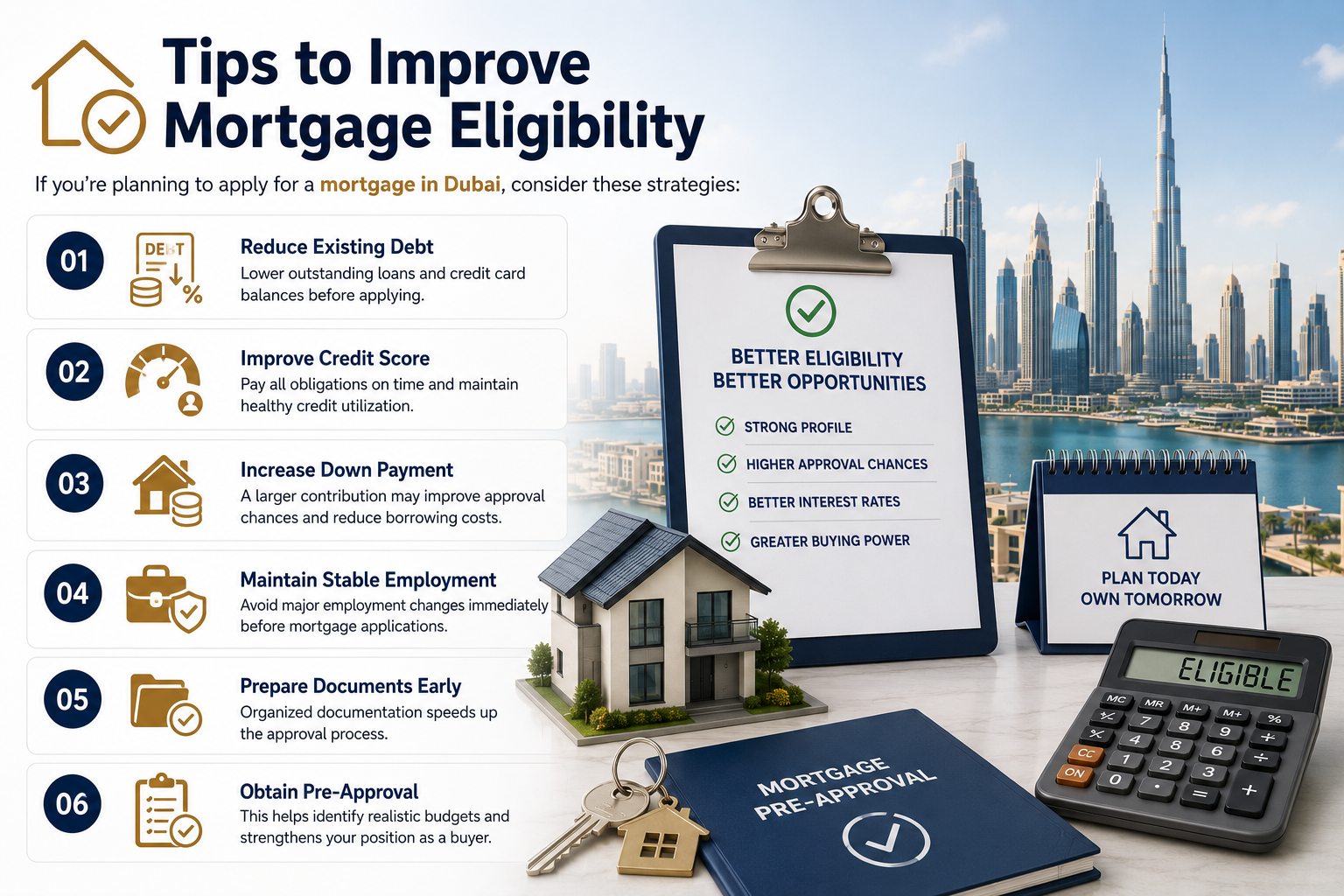
Maintain Stable Employment
Avoid major employment changes immediately before mortgage applications.
Prepare Documents Early
Organized documentation speeds up the approval process.
Obtain Pre-Approval
This helps identify realistic budgets and strengthens your position as a buyer.
Why Dubai Remains Attractive for Mortgage Buyers in 2026
Dubai’s property market continues to attract global attention because of:
- Tax-efficient investment opportunities
- Strong rental demand
- High-quality infrastructure
- Luxury lifestyle offerings
- Growing population
- Expanding freehold communities
- Long-term residency options linked to property ownership
Combined with increasingly digital mortgage platforms and competitive lending products, financing property purchases has become more accessible for both residents and overseas investors.
Final Thoughts
Understanding mortgage eligibility in Dubai is the foundation of a successful property purchase. From income requirements and credit assessments to down payment rules and debt ratios, lenders carefully evaluate every aspect of an applicant’s financial profile.
Whether you’re buying a luxury villa, waterfront apartment, family home, or investment property, securing mortgage pre-approval can significantly simplify the journey.
At Dubai Luxury Deals, we help buyers explore premium Dubai properties while connecting them with trusted mortgage solutions, making it easier to turn real estate goals into reality.
